2025-10-29 ペンシルベニア州立大学(PennState)
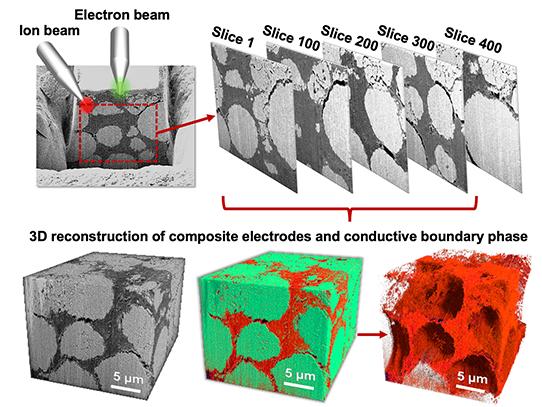
The synthetic boundary phases, colored red in the model above, form an internal network across the electrodes. This network helps facilitate the fast travel of particles across the system. Credit: Provided by Hongtao Sun. All Rights Reserved.
<関連情報>
- https://www.psu.edu/news/engineering/story/bridging-boundaries-how-are-researchers-packing-more-energy-batteries
- https://www.nature.com/articles/s41467-025-65257-2
高密度の厚膜複合電極における機械的・電気化学的性能向上のための多機能合成限界の解明 Unveiling multifunctional synthetic boundaries for enhanced mechanical and electrochemical performance in densified thick composite electrodes
Bo Nie,Seok Woo Lee,Ta-Wei Wang,Tengxiao Liu,Ju Li & Hongtao Sun
Nature Communications Published:29 October 2025
DOI:https://doi.org/10.1038/s41467-025-65257-2
Abstract
High energy density lithium-ion batteries are essential for sustainable energy solutions, as they reduce reliance on fossil fuels and lower greenhouse gas emissions. Increasing electrode thickness is an effective strategy to raise energy density at the device level, but it poses inherent scientific challenges. Thick electrodes typically require a highly porous structure (over 40% porosity) to maintain sufficient charge transport. Such porosity sharply lowers volumetric energy density, limiting use in space-constrained applications. Conversely, direct densification of thick electrodes intensifies charge diffusion limitations and exacerbates mechanochemical degradation. To overcome these trade-offs, we explore a geology-inspired, transient liquid-assisted densification process that produces dense, thick electrodes with multifunctional synthetic secondary boundaries. These boundaries provide three key benefits: (1) strain resistance that mitigates mechanochemical degradation, as demonstrated by operando full-field strain mapping; (2) enhanced charge transport across boundary phases in thick and dense electrodes (thickness > 200 μm, relative density > 85 %), leading to improved comprehensive electrochemical performance with a volumetric capacity of 420 mAh cm−3, an areal capacity of 23 mAh cm−2, and a specific (gravimetric) capacity of 195 mAh g−1 at a current density of 1 mA cm−2; and (3) tailored conducting phases that increase active material content to 92.7 % by weight, further elevating volumetric capacity to 497 mAh cm−3.