2025-10-21 琉球大学
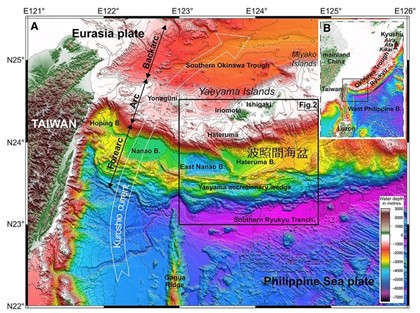
図1 南琉球の海溝から背弧(沖縄トラフ)にかけての海底地形図。黒枠内の波照間海盆が調査された海域。
<関連情報>
- https://www.u-ryukyu.ac.jp/news/71521/
- https://www.u-ryukyu.ac.jp/wp-content/uploads/2025/10/0cbc5c249907b999b275ee6688b39b8f.pdf
- https://onlinelibrary.wiley.com/doi/10.1111/sed.70043
南琉球前弧における過去20万年間の海底重力流動現象の堆積記録:巨大地震と津波のアーカイブ Sedimentary record of submarine gravity-flow events in the southern Ryukyu forearc during the last 200 000 years: archive of mega-earthquakes and tsunamis
Nathalie Babonneau, Gueorgui Ratzov, Charlotte Guerin, Mira Richa, Serge Lallemand, Michel Condomines, Patrick Bachelery, Delphine Bosch, Shu-Kun Hsu, Chih-Chieh Su …
Sedimentology Published: 31 August 2025
DOI:https://doi.org/10.1111/sed.70043
ABSTRACT
Despite high convergence velocity, the southern Ryukyu subduction has relatively low and sparse instrumental seismicity, in contrast with the Yaeyama Islands, hit by huge tsunamis over the last few thousand years. This study explores the potential of deep marine sediments to record past large earthquakes and tsunamis. During the MD214/EAGER cruise (2018), four sediment cores (12 to 23 m long) were collected in the forearc area (south of Yaeyama Islands), which is an efficient trap for gravity-flow deposits. The chrono-stratigraphic framework is established with radiocarbon dating, δ18O stratigraphy, U-series data and tephra analysis including major/trace elements and Hf-Pb-Sr-Nd isotopes. In the basin floor, bulk sedimentation rates locally exceed 60 cm/ka, while hemipelagic sedimentation rates range from 3 to 8 cm/ka, similar to values derived from U-series data in recent sediments of the boxcores. Twenty-four gravity-flow deposits were identified over the last 20 000 years, a frequency consistent with the past tsunamis recorded in the coastal sediments over the last thousand years, emphasising their interest as archives of earthquakes and major tsunamis. At a regional scale, bulk sedimentation rates fall under 10 cm/ka for 48 large-scale gravity-flow deposits over the last 200 000 years. With average recurrence periods about 3500–4000 years, these regional events could be triggered by subduction large earthquakes (M > 7). Finally, four exceptionally large submarine gravity-flow events (mega-deposits) of unclear origin have been documented over the last 200 000 years. This work provides an unprecedented time series of major submarine gravity instabilities, probably initiated by great earthquakes on this active subduction. It implies that millennial recurrence periods of great earthquakes must be considered on subduction segments where instrumental seismicity is relatively low and underlines the importance of deep marine sediments in tracing these events.