2025-10-10 シンガポール国立大学(NUS)
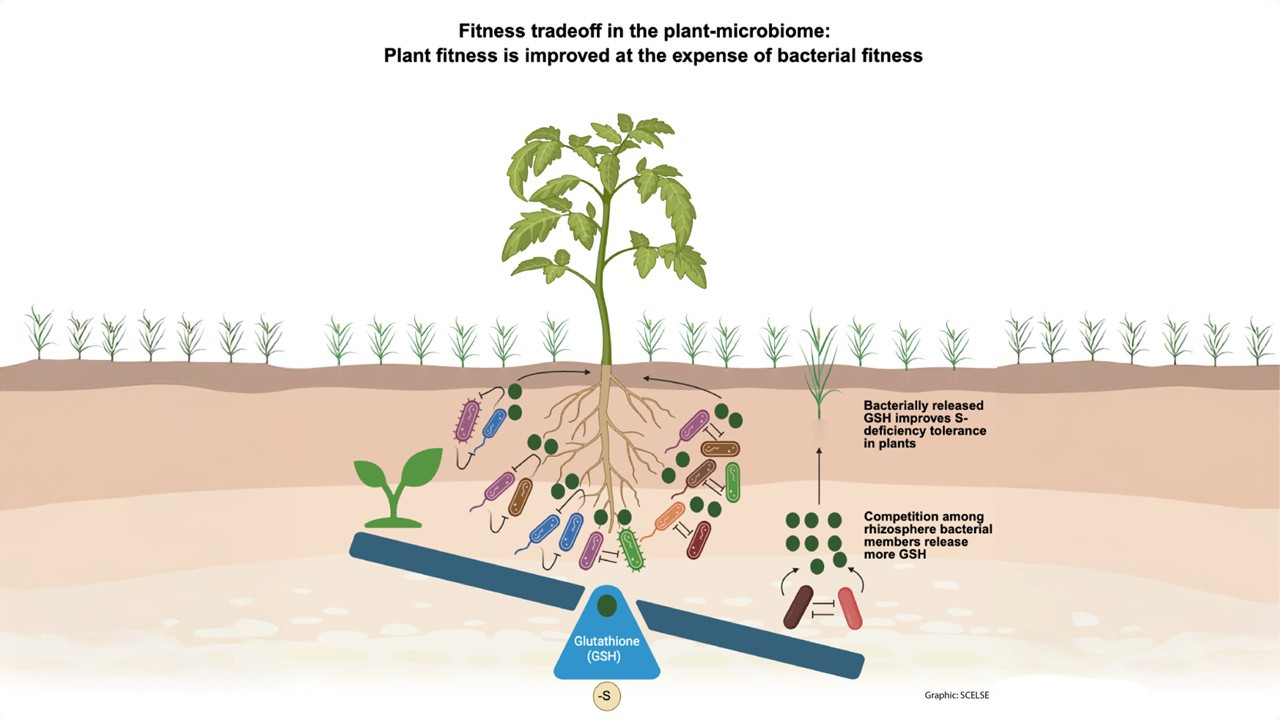
The researchers found that soil microbes competing with each other release glutathione which enhances plant growth under sulphur-deficient conditions. (Image credit: Adapted from SCELSE)
<関連情報>
- https://news.nus.edu.sg/nus-scelse-plant-microbe-strategy-boosts-crop-growth/
- https://www.cell.com/cell-host-microbe/abstract/S1931-3128(25)00373-7
細菌シグナルが植物と微生物の適応度のトレードオフを調整し、植物の硫黄欠乏耐性を高める A bacterial signal coordinates plant-microbe fitness trade-off to enhance sulfur deficiency tolerance in plants
Arijit Mukherjee ∙ Mrinmoy Mazumder ∙ Arun Verma ∙ … ∙ Raktim Bhattacharya ∙ Qi En Ooi ∙ Sanjay Swarup
Cell Host & Microbe Published:September 26, 2025
DOI:https://doi.org/10.1016/j.chom.2025.09.007
Highlights
- Alterations in plant sulfur (S) levels reshape rhizosphere microbiome and S-metabolism
- Taxonomically diverse rhizosphere bacteria promote plant growth under S-deficiency
- Bacterial competition in the rhizosphere aids plant fitness under S-deficiency
- Bacterial glutathione enhances plant growth under S-deficiency via fitness trade-off
Summary
Plant-associated microorganisms interact with each other and with host plants via intricate chemical signals, offering multiple benefits, including enhanced nutrition. We report a mechanism through which the rhizosphere microbiome improves plant growth under sulfur (S) deficiency. Disruption of plant S homeostasis caused a coordinated shift in the composition and S-metabolism of the rhizosphere microbiome. Leveraging this, we developed an 18-membered synthetic rhizosphere bacterial community (SynCom) that rescued the growth of Arabidopsis and a leafy Brassicaceae vegetable under S-deficiency. This beneficial trait is taxonomically widespread among SynCom members, with bacterial pairs providing both synergistic and neutral effects on host growth. Notably, stronger competitive interactions among SynCom members conferred greater fitness benefits to the host, suggesting a trans-kingdom (plant-microbe) fitness trade-off. Finally, guided chemical screening, deletion knockout mutants, and targeted metabolomics identified and validated microbially released glutathione (GSH) as the necessary bioactive signal that coordinates the trans-kingdom fitness trade-off and improves plant growth under sulfur limitation.