2025-10-09 日本原子力研究開発機構,環境科学技術研究所
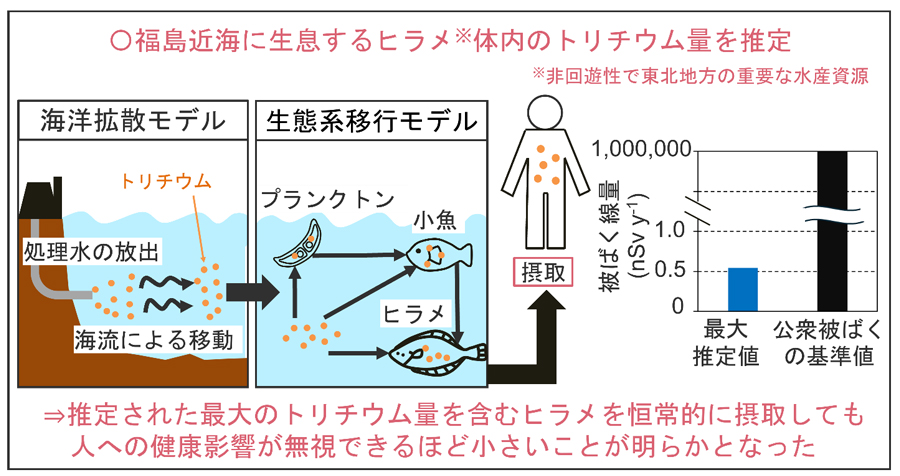
図1 本研究の概要
<関連情報>
福島第一原子力発電所から放出された処理水によるヒラメへのトリチウム蓄積は無視できる:数値シミュレーション研究 Negligible Tritium Accumulation in Japanese Flounder from Treated Water Released from Fukushima Daiichi Nuclear Power Plant: A Numerical Simulation Study
Tsubasa Ikenoue,Takashi Tani,Hideyuki Kawamura,Yuhi Satoh
Environmental Science & Technology Published: September 21, 2025
DOI:https://doi.org/10.1021/acs.est.5c04474
Abstract
Since 2023, ALPS-treated water containing tritium from the Fukushima Daiichi Nuclear Power Plant (1F) accident has been released into the ocean. Monitoring of seafood collected near the Fukushima coast has shown negligible increases in the tritium concentration. However, this monitoring has limitations, including delayed data release and a limited sample size. Therefore, a predictive estimation is necessary to assess the potential for high tritium accumulation in seafood. This study estimated tritium concentrations in Japanese flounder near the Fukushima coast using numerical simulations. The estimation combined an oceanic dispersion model for tritiated water (HTO) with a tritium transfer model for the marine food web. Tritium accumulation was evaluated as organically bound tritium (OBT), the long-retaining chemical form of tritium in organisms. First, the dispersion model’s ability to reproduce HTO concentrations in seawater was validated using actual measurement data from the Fukushima coast, showing good agreement. Subsequently, the OBT concentrations in flounder were estimated under the hypothetical maximum release scenario of the treated water. The estimation suggested that even within 100 km of 1F, the maximum concentration of the OBT was comparable with natural levels of tritium in environmental waters. Additionally, the maximum concentration in the flounder remained at a negligible level for internal radiation exposure through consumption.