
2025-10-02 科学技術振興機構,大阪大学,ZEN大学,東京大学
Web要約 の発言:
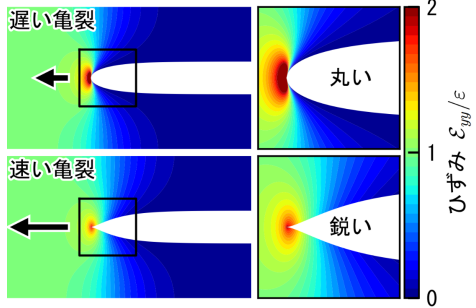
図 1 亀裂の進展速度による亀裂先端形状の変化とひずみ分布
(上図)亀裂の進展速度が遅いときは亀裂先端が丸い放物線形状を示す。
(下図)亀裂の進展速度が速くなると、粘弾性効果により亀裂先端が鋭くとがる。ゴムやゲルの破壊実験では、縦幅が数センチメートルから数十センチメートルのサンプルを用いることが多い。なお、亀裂先端のとがり具合は、材料の粘弾性緩和時間(ゴム状態から粘性支配の状態に移り変わる時間スケール)と亀裂進展速度の積から決まる(図 2 参照)。
<関連情報>
- https://www.jst.go.jp/pr/announce/20251002-2/index.html
- https://www.jst.go.jp/pr/announce/20251002-2/pdf/20251002-2.pdf
- https://journals.aps.org/prresearch/abstract/10.1103/4gnw-ys42
粘弾性亀裂伝播における破壊プロファイルの解析的表現 Analytical expression for fracture profile in viscoelastic crack propagation
Hokuto Nagatakiya, Naoyuki Sakumichi, Shunsuke Kobayashi, and Ryuichi Tarumi
Physical Review Research Published: 1 October, 2025
DOI: https://doi.org/10.1103/4gnw-ys42
Abstract
We derive an analytical expression for the strain field during steady-state crack propagation in viscoelastic solids described by the standard linear solid (Zener) model. This expression reveals three regions in the fracture profile and in the strain field ahead of the crack tip, each distinguished by power-law exponents that evolve with distance from the crack tip. These features explain the experimentally observed crack-tip sharpening in rubbers and gels as the crack-propagation velocity increases, often associated with catastrophic failure triggered by a velocity jump. Furthermore, we establish de Gennes’ viscoelastic trumpet on a continuum-mechanical foundation, previously based only on a scaling argument.



