
2025-10-01 カリフォルニア大学リバーサイド校 (UCR)
Web要約 の発言:
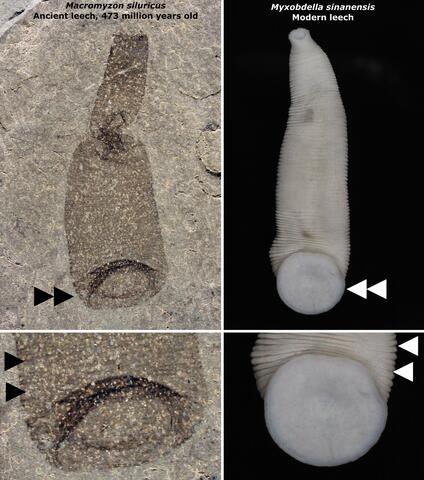
The fossil leech compared with a modern leech. Double arrows = large caudal sucker used for attachment, single arrows = body annulations. (Andrew J Wendruff/Otterbein University/ Takafumi Nakano/Kyoto University)
<関連情報>
- https://news.ucr.edu/articles/2025/10/01/rare-fossil-reveals-ancient-leeches-werent-bloodsuckers
- https://peerj.com/articles/19962/
最初のヒルの化石は、ヒルディニダンの起源より2億年も古いと推定される The first leech body fossil predates estimated hirudinidan origins by 200 million years
Danielle de Carle, Rafael Eiji Iwama, Andrew J. Wendruff, Loren E. Babcock, Karma Nanglu
PeerJ Published:October 1, 2025
DOI:https://doi.org/10.7717/peerj.19962
Abstract
Clitellata is a major annelid clade comprising oligochaetes (e.g., earthworms) and hirudineans (e.g., leeches). Due to their scant fossil record, the origins of clitellates, particularly Hirudinea, are poorly known. Here, we describe the first leech body fossil, Macromyzon siluricus, gen. et sp. nov., from the Brandon Bridge Formation (Waukesha Lagerstätte). This fossil, which is preserved in exceptional detail, possesses several hirudinean soft-tissue synapomorphies–including a large sucker at the posterior end and sub-divided segments–and phylogenetic analyses resolve Macromyzon siluricus as a stem leech. Its age, 437.5–436.5 Ma, is consistent with early age estimates for the origin of clitellates, and predates molecular-clock-based estimates of hirudinidan origins by at least 200 million years. These findings suggest that the earliest true leeches were marine and that, contrary to prevailing hypotheses, were unlikely to have fed on vertebrate blood.


