2025-09-25 中国科学院(CAS)
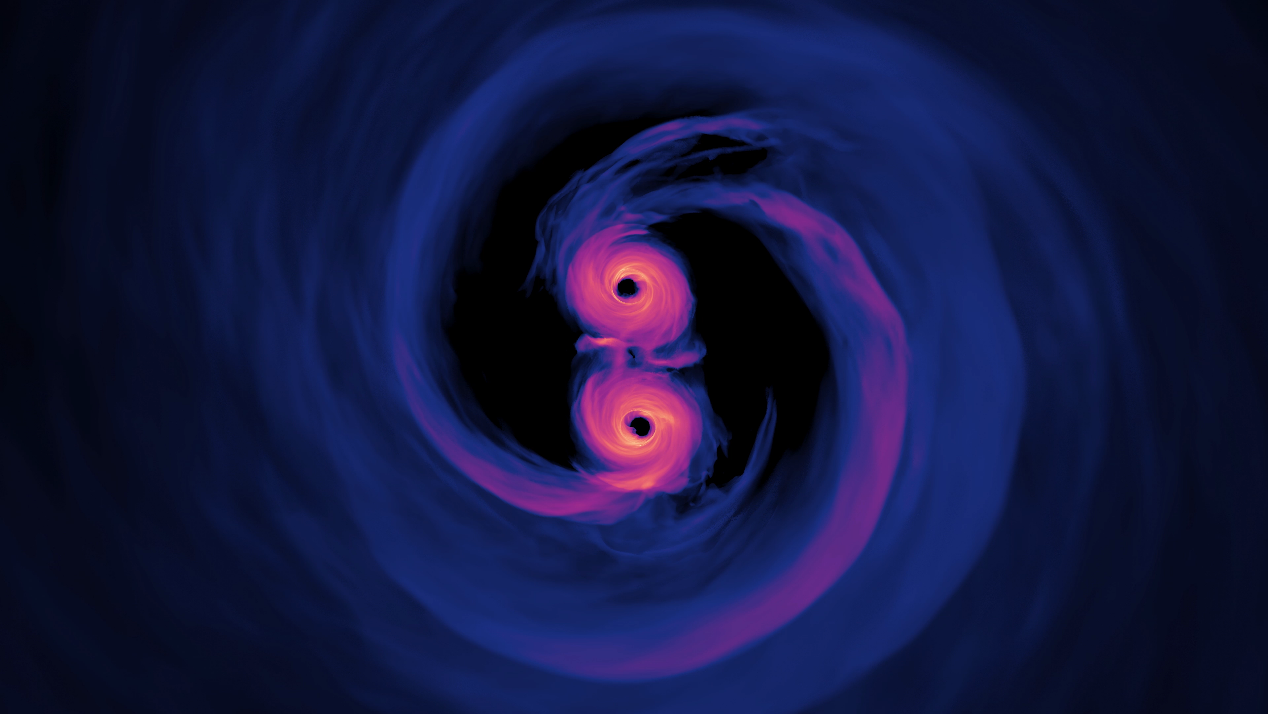 Simulating the full band light emitted by a binary supermassive black hole system in a transparent medium, observed from directly above the galactic disk. (Credit: NASA’s Goddard Space Flight Center/Scott Noble; simulation data)
<関連情報>
- https://english.cas.cn/newsroom/research_news/phys/202509/t20250926_1055738.shtml
- https://iopscience.iop.org/article/10.3847/1538-4357/adf4d1
SDSS-IV MaNGA: 棒銀河における二重ピーク狭輝線スパクセルの物理的起源 SDSS-IV MaNGA: Physical Origins of Double-peaked Narrow Emission-line Spaxels in Barred Galaxies
Jiajie Qiu, Shiyin Shen, Ruixiang Chang, Qianwen Zhao, and Qi Zeng
The Astrophysical Journal Published: 2025 September 11
DOI:10.3847/1538-4357/adf4d1
Abstract
The physical origins of double-peaked narrow emission-line spaxels (DPSs) in barred galaxies are explored through the analysis of a sample of 72 barred double-peaked emission-line galaxies (DPGs) extracted from the MaNGA data set. In this study, we examine two potential scenarios: the gas inflow along the bar and the formation of a bar-induced gaseous nuclear ring. By applying a classical galactic dynamics model, we calculate the radii and rotational velocities of the nuclear rings for all barred DPGs and compare them with the observed properties of their DPSs. Our analysis reveals a significant correlation between the predicted radii of the nuclear rings and the maximum centric distances of the DPSs, as well as a marginal correlation between the predicted rotational velocities of the nuclear rings and the observed maximum velocity differences of the DPSs. These findings provide strong evidence to support the hypothesis that the DPSs of a barred DPG in MaNGA primarily originate from the convolution of the point-spread function effect with its bar-induced fast-rotating gaseous nuclear ring.