
2025-09-25 ミシガン大学
<関連情報>
- https://news.umich.edu/conspiracy-content-drives-anti-establishment-sentiment-on-tiktok-youtube/
- https://arxiv.org/abs/2508.16453
TikTokにおける反体制感情:ソーシャルメディアにおける影響力と専門知識の理解への影響 Anti-establishment sentiment on TikTok: Implications for understanding influence(rs) and expertise on social media
Tianliang Xu, Ariel Hasell, Sabina Tomkins
arXiv Submitted on 22 Aug 2025
DOI:https://doi.org/10.48550/arXiv.2508.16453
Abstract
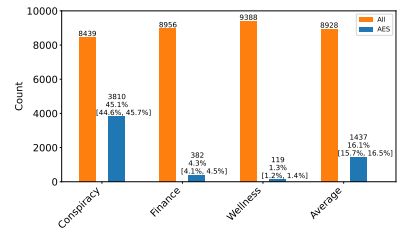
Distrust of public serving institutions and anti-establishment views are on the rise (especially in the U.S.). As people turn to social media for information, it is imperative to understand whether and how social media environments may be contributing to distrust of institutions. In social media, content creators, influencers, and other opinion leaders often position themselves as having expertise and authority on a range of topics from health to politics, and in many cases devalue and dismiss institutional expertise to build a following and increase their own visibility. However, the extent to which this content appears and whether such content increases engagement is unclear. This study analyzes the prevalence of anti-establishment sentiment (AES) on the social media platform TikTok. Despite its popularity as a source of information, TikTok remains relatively understudied and may provide important insights into how people form attitudes towards institutions. We employ a computational approach to label TikTok posts as containing AES or not across topical domains where content creators tend to frame themselves as experts: finance and wellness. As a comparison, we also consider the topic of conspiracy theories, where AES is expected to be common. We find that AES is most prevalent in conspiracy theory content, and relatively rare in content related to the other two topics. However, we find that engagement patterns with such content varies by area, and that there may be platform incentives for users to post content that expresses anti-establishment sentiment.



