2025-09-25 国立天文台
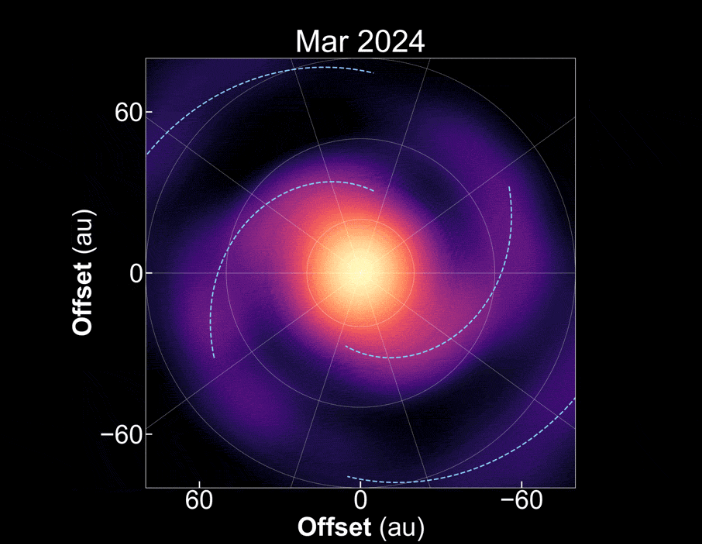
アルマ望遠鏡の観測で捉えた、原始惑星系円盤の渦巻き状の構造がダイナミックに変化している様子。(クレジット:ALMA(ESO/NAOJ/NRAO), Tomohiro Yoshida et al.) 画像(3.6MB)
<関連情報>
- https://www.nao.ac.jp/news/science/2025/20250925-alma.html
- https://alma-telescope.jp/news/press/vimage-202509.html
- https://www.nature.com/articles/s41550-025-02639-y
重力不安定な原始惑星円盤における螺旋の巻き運動 Winding motion of spirals in a gravitationally unstable protoplanetary disk
Tomohiro C. Yoshida,Hideko Nomura,Kiyoaki Doi,Marcelo Barraza-Alfaro,Richard Teague,Kenji Furuya,Yoshihide Yamato & Takashi Tsukagoshi
Nature Astronomy Published:24 September 2025
DOI:https://doi.org/10.1038/s41550-025-02639-y
Abstract
The discovery of wide-orbit giant exoplanets has posed a challenge to our conventional understanding of planet formation through the coagulation of dust grains and planetesimals and the subsequent accretion of protoplanetary disk gas. As an alternative mechanism, the direct in situ formation of planets or planetary cores by gravitational instability (GI) in protoplanetary disks has been proposed. However, observational evidence for GI in regions where wide-orbit planets form is still lacking. Theoretical studies predict that GI induces spiral arms moving at the local Keplerian speed in a disk. Based on several high-angular-resolution observations over a 7-year time baseline using the Atacama Large Millimeter/submillimeter Array, here we report the evidence for spiral arms following the Keplerian rotation in the dust continuum disk around the young star IM Lup. This demonstrates that GI can operate in wide-orbit planet-forming regions, establishing it as a plausible formation mechanism for such planets.