
2025-09-24 電気通信大学
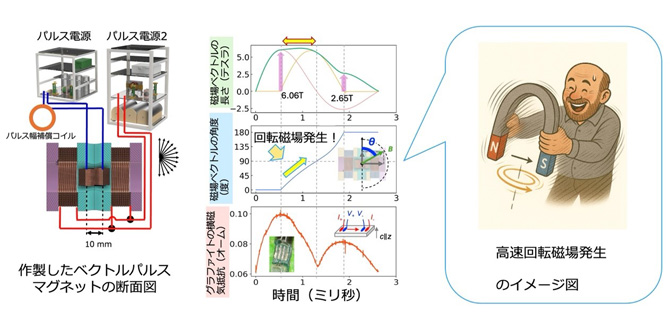
図1:製作したベクトルパルスマグネット(左)、回転磁場発生(中央)、磁場を高速回転させるイメージ図(右)
<関連情報>
- https://www.uec.ac.jp/news/newsrelease/2025/20250924_7191.html
- https://www.uec.ac.jp/about/publicity/news_release/2025/pdf/20250924_7191.pdf
- https://pubs.aip.org/aip/apl/article-abstract/127/12/122403/3364349/Vector-pulse-magnet
ベクトルパルスマグネット
Vector pulse magnet
Kosuke Noda;Kenta Seki;Dilip Bhoi;Kazuyuki Matsubayashi;Kazuto Akiba;Akihiko Ikeda
Applied Physics Letters Published:September 23 2025
DOI:https://doi.org/10.1063/5.0284842
The underlying symmetry of the crystal, electronic structure, and magnetic structure manifests itself in the anisotropy of materials’ properties, which is a central topic of the present condensed matter research. However, it demands such a considerable effort to fill the explorable space that only a small part has been conquered. We report a vector pulse magnet (VPM) as an alternative experimental technique to control the direction of applied magnetic fields, which may complement the conventional methods with its characteristic features. The VPM combines a conventional pulse magnet and a vector magnet. The VPM can create vector-pulsed magnetic fields and swiftly rotating-pulsed magnetic fields. As a demonstration, the three-dimensional magnetoresistance measurement of a highly oriented pyrolytic graphite is carried out using the AC four-probe method at 4.5 K and 6 T. The two-dimensional electronic structure of graphite is visualized in the three-dimensional magnetoresistance data. One can uncover the rotational and time-reversal symmetry of materials using a VPM and a variety of measurement techniques.


