2025-09-25 韓国基礎科学研究院(IBS)
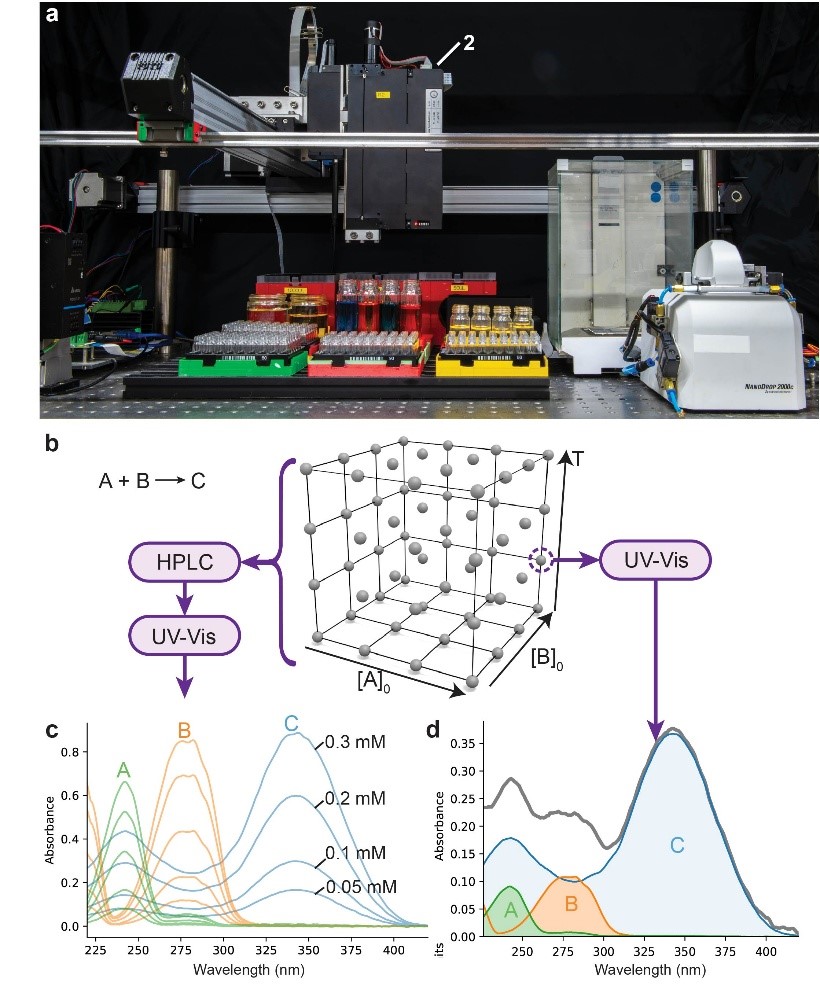
Figure 1. Automated reaction platform and optical yield determination. a. platform overview. b., c., d., The robot explores a reaction space where two starting materials (A and B) combine to form product C, with outcomes varying depending on their concentrations and temperature. Using UV-Vis spectroscopy, the system records spectra of purified products at different concentrations. These reference patterns are then used to untangle the complex spectra from each reaction mixture, allowing the robot to precisely estimate product yields across thousands of conditions..
<関連情報>
- https://www.ibs.re.kr/cop/bbs/BBSMSTR_000000000738/selectBoardArticle.do?nttId=26155&pageIndex=1&searchCnd=&searchWrd=
- https://www.nature.com/articles/s41586-025-09490-1
ロボット支援による化学反応ハイパースペースとネットワークのマッピング Robot-assisted mapping of chemical reaction hyperspaces and networks
Yankai Jia,Rafał Frydrych,Yaroslav I. Sobolev,Wai-Shing Wong,Bibek Prajapati,Daniel Matuszczyk,Yasemin Bilgi,Louis Gadina,Juan Carlos Ahumada,Galymzhan Moldagulov,Namhun Kim,Eric S. Larsen,Maxence Deschamps,Yanqiu Jiang & Bartosz A. Grzybowski
Nature Published:24 September 2025
DOI:https://doi.org/10.1038/s41586-025-09490-1
Abstract
Despite decades of investigation, it remains unclear (and hard to predict1,2,3,4) how the outcomes of chemical reactions change over multidimensional ‘hyperspaces’ defined by reaction conditions5. Whereas human chemists can explore only a limited subset of these manifolds, automated platforms6,7,8,9,10,11,12 can generate thousands of reactions in parallel. Yet, purification and yield quantification remain bottlenecks, constrained by time-consuming and resource-intensive analytical techniques. As a result, our understanding of reaction hyperspaces remains fragmentary7,9,13,14,15,16. Are yield distributions smooth or corrugated? Do they conceal mechanistically new reactions? Can major products vary across different regions? Here, to address these questions, we developed a low-cost robotic platform using primarily optical detection to quantify yields of products and by-products at unprecedented throughput and minimal cost per condition. Scanning hyperspaces across thousands of conditions, we find and prove mathematically that, for continuous variables (concentrations, temperatures), individual yield distributions are generally slow-varying. At the same time, we uncover hyperspace regions of unexpected reactivity as well as switchovers between major products. Moreover, by systematically surveying substrate proportions, we reconstruct underlying reaction networks and expose hidden intermediates and products—even in reactions studied for well over a century. This hyperspace-scanning approach provides a versatile and scalable framework for reaction optimization and discovery. Crucially, it can help identify conditions under which complex mixtures can be driven cleanly towards different major products, thereby expanding synthetic diversity while reducing chemical input requirements.