2025-09-14 中国科学院(CAS)
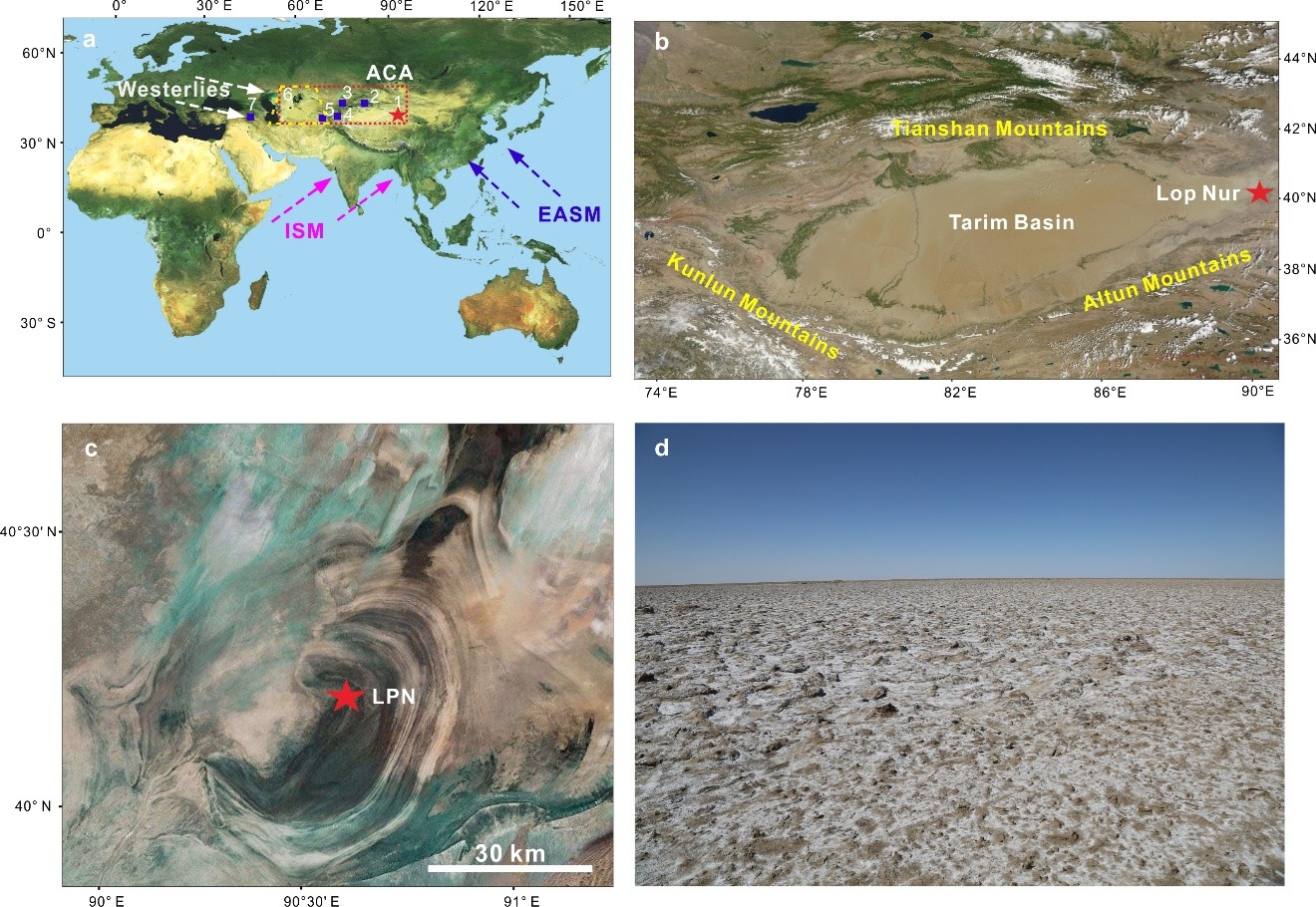 Today’s Lop Nur (Image by YAO Yifeng)
<関連情報>
- https://english.cas.cn/newsroom/research_news/earth/202509/t20250917_1054977.shtml
- https://www.sciencedirect.com/science/article/abs/pii/S0031018225005346
中央アジア東部ロプノールにおける多指標分析が明らかにした更新世末期から完新世中期にかけての植生変化 Latest Pleistocene to mid-Holocene vegetation changes revealed by multi-proxy analyses at Lop Nur in the eastern Central Asia
Yi-Feng Yao, Kai-Qing Lu, Feng Qin, Guo-An Wang, Qin-Min Yang, Xin-Ying Zhou, David K. Ferguson, Gan Xie, Jin-Feng Li, Bin Sun, Stephen Blackmore, Yu-Fei Wang
Palaeogeography, Palaeoclimatology, Palaeoecology Available online: 1 September 2025
DOI:https://doi.org/10.1016/j.palaeo.2025.113249
Highlights
- Interdisciplinary analyses revealed vegetation and environmental changes at Lop Nur during ∼23.3–7.2 cal kyr BP.
- Climate data during this period were estimated using the quantitative reconstruction method.
- Solar activity and westerlies drove water circulation in the region, further triggering the changes in desert vegetation.
Abstract
The dried-up lake bed of Lop Nur is a well-known example of environmental change in arid Central Asia (ACA) and witnessed the rise and fall of a major Silk Road civilization. However, a lack of interdisciplinary analyses, quantitative climate data together with inadequate characterization of the desert vegetation has hindered a comprehensive understanding of past vegetation and environmental changes in the region. Here we perform a high-resolution analysis of pollen, grain size, stable carbon and nitrogen isotopes from a 617-cm sediment core from Lop Nur to reconstruct vegetational and environmental changes between ∼23.3 to 7.2 cal kyr BP and understand their potential drivers. Results show that variations in solar activity and westerlies drove water circulation in the region, triggering an alternateon between temperate shrubby desert and temperate semi-shrubby/dwarf semi-shrubby desert, accompanied by the fluctuations in lake level fed by alpine meltwater. Lake organic matter was mainly derived from aquatic vascular plants and phytoplankton in the latest Pleistocene (∼23.3–11.6 cal kyr BP), but shifted to a greater diversity of sources (soil, C3 terrestrial plants, aquatic vascular plants and phytoplankton) in the early to middle Holocene (11.6–7.2 cal kyr BP), while the nitrogen levels in the lake sediment were mainly controlled by soil erosion, and only marginally influenced by atmospheric nitrogen deposition. These findings provide a past analog for the prediction of future environmental change and ecosystem sustainable development in ACA under the scenario of global change.