
2025-09-19 ニューヨーク大学 (NYU)
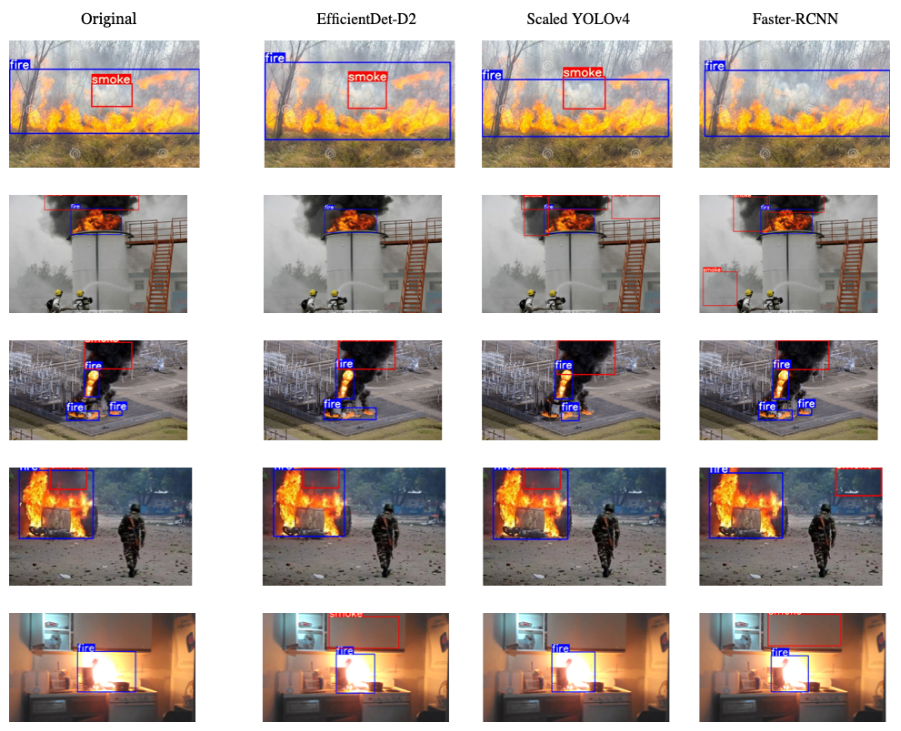
The AI system analyzes raw video footage (left column) to detect fires and smoke using an AI ensemble. Blue boxes show detected fire, red boxes show detected smoke. The system requires multiple algorithms to agree before confirming a fire detection. Image credit: Prabodh Panindre
<関連情報>
- https://www.nyu.edu/about/news-publications/news/2025/september/nyu-tandon-researchers-develop-new-ai-system-that-leverages-stan.html
- https://ieeexplore.ieee.org/abstract/document/11127189
ライブ映像ストリームにおけるリアルタイム遠隔火災・煙検知のための人工知能統合自律型IoT警報システム Artificial Intelligence-Integrated Autonomous IoT Alert System for Real-Time Remote Fire and Smoke Detection in Live Video Streams
Prabodh Panindre; Shantanu Acharya; Nanda Kalidindi; Sunil Kumar
IEEE Internet of Things Journal Published:19 August 2025
DOI:https://doi.org/10.1109/JIOT.2025.3598979
Abstract
—Video surveillance via closed-circuit television (CCTV) is ubiquitous across the world today, with a multiplicity of monitoring objectives. However, IoT-enabled real-time automated detection of fire and smoke has not been a part of the CCTV repertoire so far. The present study addresses the feasibility and establishes a methodology for detecting fire and smoke solely from live video streams using a novel IoT-centric framework with minimal latency and higher accuracy, and without the need for additional data, such as from thermal or multi-spectral imaging streams. In our design, CCTV/IP cameras serve purely as Perception Layer nodes that stream raw video (without ondevice inference or pre-processing), transmitting via IoT network protocols (RTSP/RTMP/SDP) to a centralized Application Layer for AI inference. It is shown that available artificial intelligence (AI) object detection models (EfficientDet, Faster-RCNN, YOLO, and their variants) that have been trained and tested with a comprehensive dataset of fire and smoke images are able to detect fire and smoke from video streams with varied accuracies that make the stand-alone models unreliable for practical applications. By uniquely integrating multiple AI algorithms into an end-toend IoT architecture (Perception–Network–Application layers), as well as incorporating a novel technique of monitoring and analyzing the area of dynamically assigned bounding boxes around detected fire and smoke regions, the overall accuracy is significantly increased, creating a robust system for detecting all classes of fire within the same system. The dynamic analysis of bounding box areas over consecutive frames allows the system to differentiate between real, live fires, and static images or objects that resemble fire, thereby significantly reducing false positives. The framework leverages IoT camera nodes streaming via RTSP/RTMP/SDP to cloud-hosted ingestion servers on Amazon Web Service (AWS) EC2 (Application Layer), where video frames are continuously extracted and fed to an AI ensemble. Detected events, validated by multimodel consensus, are stored in S3 and trigger alerts in real-time via AWS SNS/SES based on custom risk thresholds. The mAP@0.5 and detection time of Scaled-YOLOv4 (80.6%, 0.016 seconds/video frame) and EfficientDet (78.1%, 0.019 seconds/video frame) are found to be better than that of Faster-RCNN (67.8%, 0.054 seconds/video frame), highlighting the applicability of Scaled-YOLOv4 and EfficientDet for highthroughput, low-latency real-time detections within IoT-driven surveillance ecosystems.


