2025-08-29 マックス・プランク研究所
<関連情報>
- https://www.mpg.de/25275653/changes-in-cloud-altitude-have-minimal-impact-on-climate-sensitivity
- https://acp.copernicus.org/articles/25/9075/2025/
気候感度に対する長波長雲の影響を理解するための概念的枠組み A conceptual framework for understanding longwave cloud effects on climate sensitivity
Lukas Kluft, Bjorn Stevens, Manfred Brath, and Stefan A. Buehler
Atmospheric Chemistry and Physics Published:20 Aug 2025
DOI:https://doi.org/10.5194/acp-25-9075-2025
Abstract
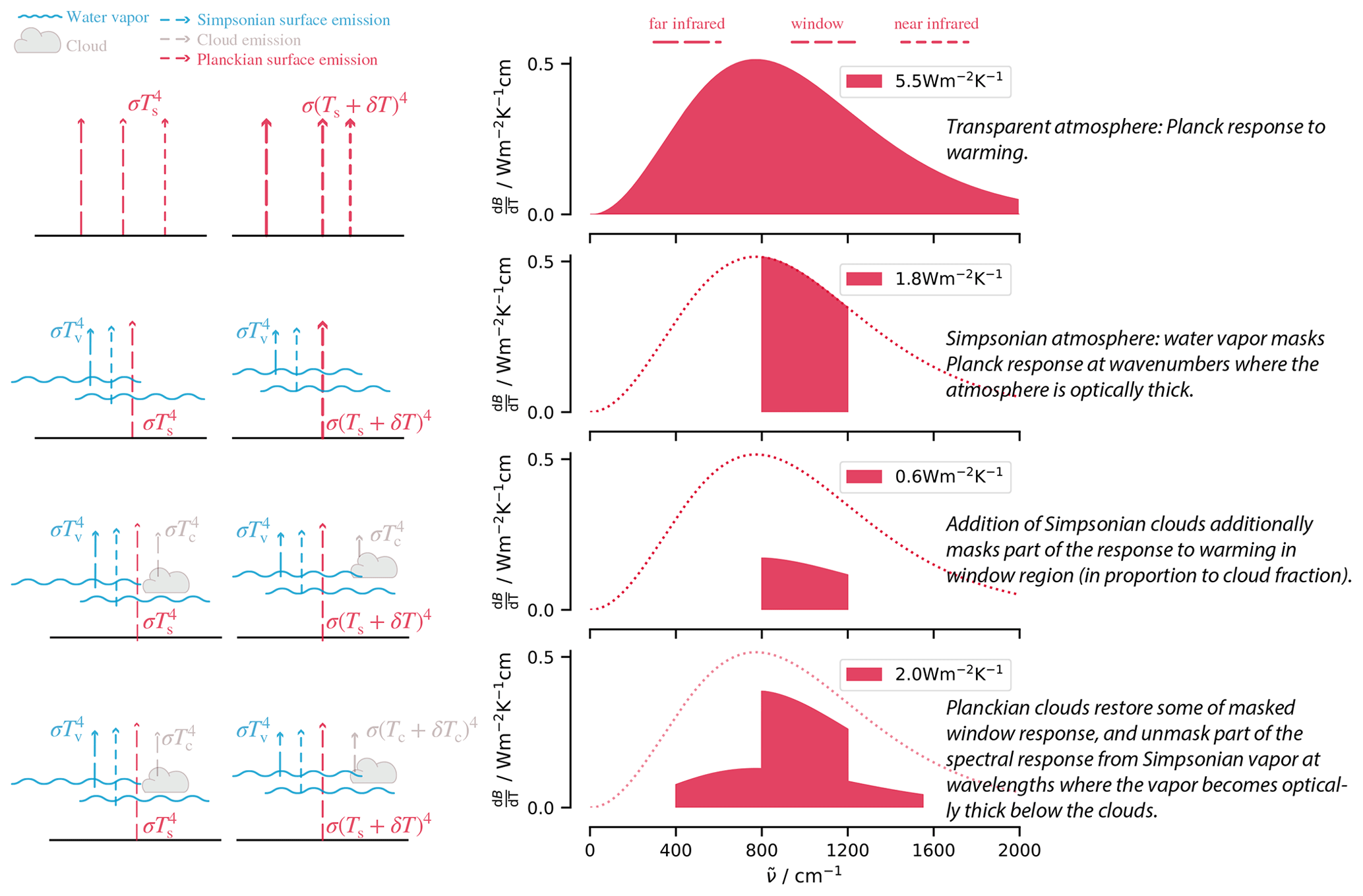
We add idealized clouds into a single-column model and show that cloud radiative effects, as observed from satellites, can be reproduced by a combination of high- and either low- or mid-level clouds. To quantify all-sky climate sensitivity, we adopt the “fixed-cloud-albedo” ansatz as the null hypothesis for climate sensitivity. Our ansatz assumes an understanding of how clouds distribute themselves in temperature space, but it assumes no change in cloud albedo. Drawing only distributions which match the cloud radiative effects of present-day observations yields a mean fixed-albedo climate sensitivity of 2.2 K (also keeping surface albedo fixed), slightly smaller than its clear-sky value. This small number arises from two compensating effects: the dominance of cloud masking of the radiative response, primarily by mid-level clouds, which are assumed not to change with temperature, and a reduction in the radiative forcing due to the masking effect by high clouds. Giving more prominence to low-level clouds, which are assumed to change their temperature with warming, reduces estimates of the fixed-albedo climate sensitivity to 2.0 K. This provides a baseline to which changes in surface albedo and a presumed reduction in cloud albedo would add to.