
2025-09-09 中国科学院(CAS)
<関連情報>
- https://english.cas.cn/newsroom/research_news/earth/202509/t20250910_1054327.shtml
- https://www.nature.com/articles/s41467-025-63032-x
非温度環境要因がチベット高原における温暖化誘発の21世紀永久凍土劣化を調節する Non-temperature environmental drivers modulate warming-induced 21st-century permafrost degradation on the Tibetan Plateau
Fu Ziteng,Wu Qingbai,Chen Anping,Wang Luyang,Jiang Guanli,Gao Siru,Yun Hanbo & Chen ji
Nature Communications Published:14 August 2025
DOI:https://doi.org/10.1038/s41467-025-63032-x
Abstract
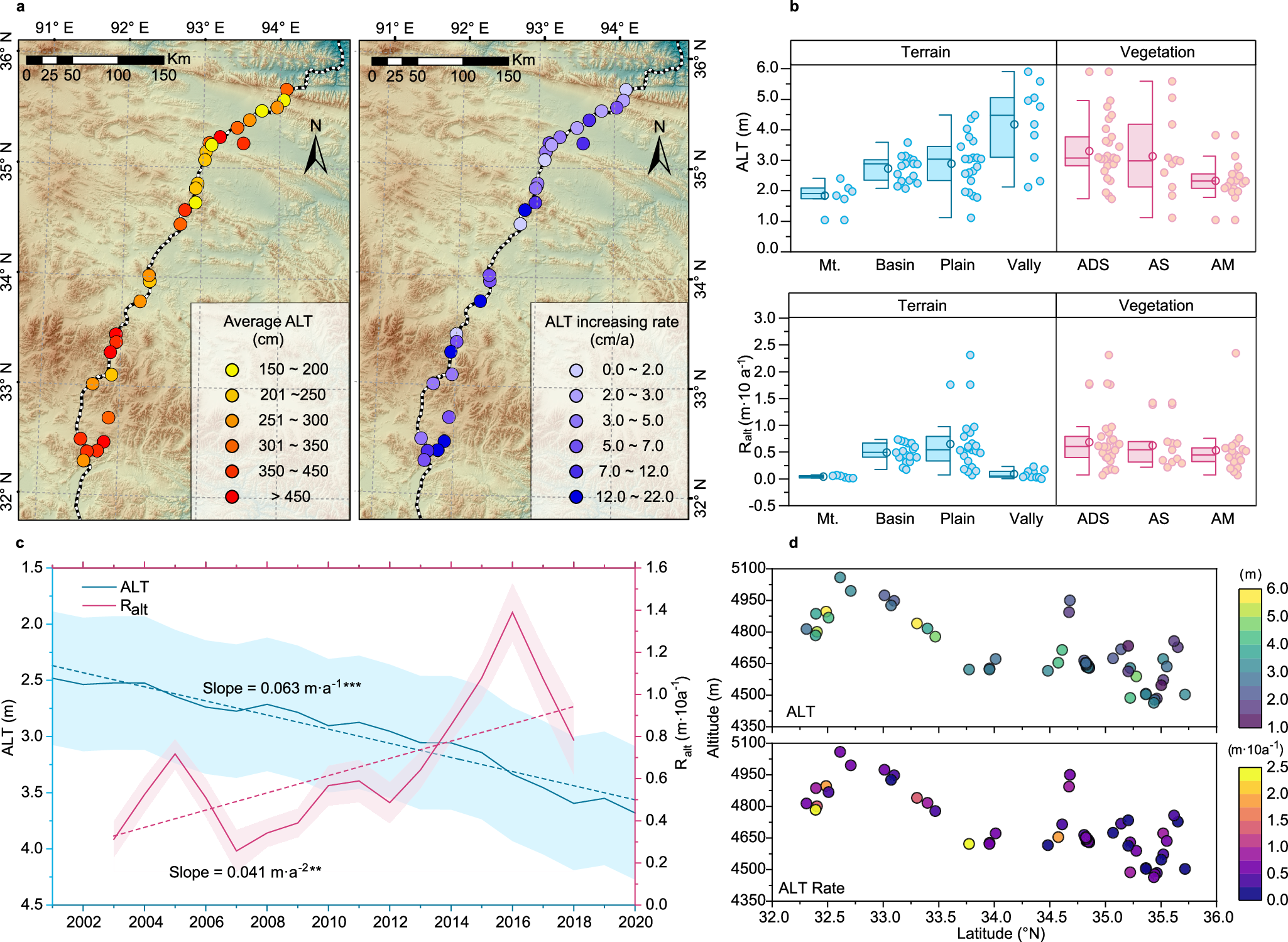
The world’s largest continuous alpine permafrost layer on the Tibet Plateau (TP), is increasingly threatened by warming leading permafrost degradation that disrupts carbon, water, and nutrient cycling, and threatens ecosystem services and infrastructure stability. However, it remains unclear how permafrost sensitivity to warming varies across the TP and over time. By compiling a 20-year (2001–2020) dataset from 55 in situ monitoring sites, we find permafrost thawing rates increased from 45 ± 15 cm·10a−1 (2001–2010) to 86 ± 30 cm·10a−1 (2011-2020), while the temperature increasing rates at the top of permafrost rose from 0.15 ± 0.16 oC·10a−1 to 0.38 ± 0.22 oC·10a−1. Temperature explains 18% and 17% of the observed changes in active layer thickness and permafrost temperature, respectively, while non-temperature variables collectively account for 45%. Notably, precipitation patterns exert contrasting effects on permafrost: Increasing precipitation south of 34oN leads to active layer thinning and permafrost cooling, while in the north it deepens the active layer and warms permafrost. Our findings underscore the crucial role of non-temperature variables in modulating permafrost responses to climate change, which is important for refining projections of carbon, nutrient, and water cycling and for safeguarding critical infrastructures in the TP and other permafrost regions.


