2005-09-08 東北大学
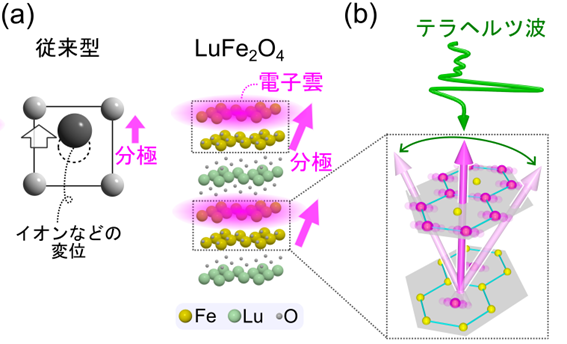
図1. 結晶構造と本研究の実験の模式図。(a)従来型の強誘電体では重いイオンなどの変位によって分極が生じる。一方、電子強誘電体LuFe2O4では軽い電子雲の変形によって分極が生じる。結晶構造は、鉄(Fe)原子からなる層と、Luからなる希土類層が交互に積層している。(b)Fe層で生じる強誘電分極と、テラヘルツ波(図中の緑矢印)による分極駆動。分極は電子(図中の紫球)のチームプレーによって生じているため刺激に敏感で、高速に制御できる。
<関連情報>
- https://www.tohoku.ac.jp/japanese/2025/09/press20250908-01-terahertz.html
- https://www.tohoku.ac.jp/japanese/newimg/pressimg/tohokuuniv-press20250908_01_terahertz.pdf
- https://journals.aps.org/prl/abstract/10.1103/fryl-jjnj
LuFe2O4 における室温での電子強誘電異方性のテラヘルツ場制御 Terahertz Field Control of Electronic-Ferroelectric Anisotropy at Room Temperature in LuFe2O4
Hirotake Itoh, Ryusei Minakami, Hongwu Yu, Ryohei Tsuruoka, Tatsuya Amano, Yohei Kawakami, Shin-ya Koshihara, Kosuke Fujiwara, Naoshi Ikeda et al.
Physical Review Letters Published: 4 September, 2025
DOI: https://doi.org/10.1103/fryl-jjnj
Abstract
Electronic ferroelectrics, with polarization induced by strongly correlated charges, are expected to show ultrafast, huge, and flexible responses required in future optoelectronics. Although the challenges for ultrafast manipulation of such a polarization are ongoing, the expected advantages have been unclear. In this Letter, we demonstrate an unprecedentedly large increase by a factor of 2.7 in optical second harmonic generation at room temperature in the prototypical electronic ferroelectrics, the rare-earth ferrite LuFe2O4, by applying a terahertz field of 260 kV/cm. The transient anisotropy indicates that the direction of macroscopic polarization can be controlled three dimensionally on subpicosecond timescales, offering additional degrees of freedom in controlling polarization. Although the polarization response is in phase concerning the terahertz field, its sensitivity increased with delay, indicating that cooperative interactions among microscopic domains play an important role in the unprecedented response.