2025-09-03 産業技術総合研究所
産総研と東京大学の研究チームは、日本列島と朝鮮半島に分布する白亜紀~古第三紀の火成岩のSr・Nd同位体データを統合解析し、日本列島で約9,000万~6,000万年前に発生した大規模カルデラ噴火集中現象「イグニンブライト・フレアアップ」の原因を解明した。マグマ組成が約1億年前を境に急変したことから、当時、大陸プレート直下に熱いマントルが流入したと判明。この流入は、古い海洋プレートがマントル側にめくれる「スラブ・ロールバック」により誘発されたと考えられる。火成岩の化学組成と噴火履歴の比較から、マントルからの熱供給増大がフレアアップを駆動したことも示された。この成果は、沈み込み帯での火山活動史の理解を拡張し、世界各地での巨大噴火現象の発生条件解明に貢献する。研究成果は Progress in Earth and Planetary Science に掲載。
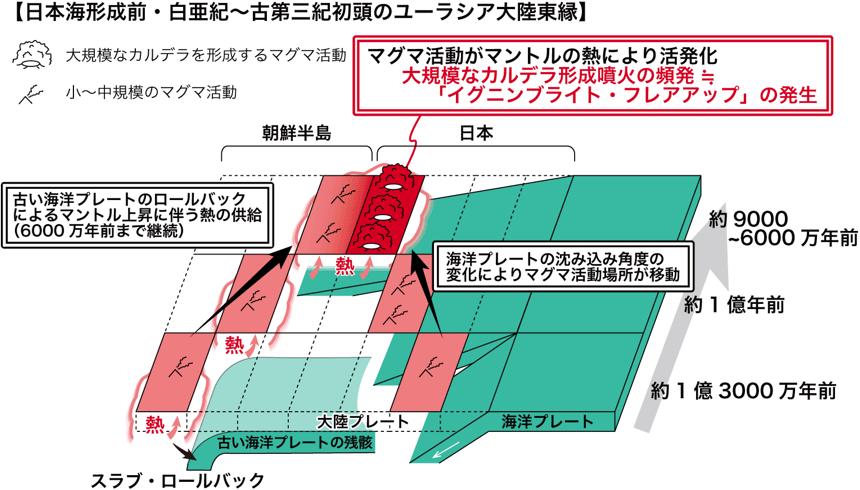
日本での白亜紀〜古第三紀「イグニンブライト・フレアアップ」の発生の仕組み
<関連情報>
- https://www.aist.go.jp/aist_j/press_release/pr2025/pr20250903/pr20250903.html
- https://progearthplanetsci.springeropen.com/articles/10.1186/s40645-025-00755-x
白亜紀末-古第三紀日本のイグニムブライト噴火は高温マントル流入によって促進された Ignimbrite flare-up in Late Cretaceous–Paleocene Japan empowered by hot mantle inflow
Ken Yamaoka,Tokiyuki Morohoshi,Daisuke Sato & Kazuto Mikuni
Progress in Earth and Planetary Science Published:02 September 2025
DOI:https://doi.org/10.1186/s40645-025-00755-x
Abstract
The contribution of subduction parameters, mantle flow, and magmatic systems to the triggering of ignimbrite flare-ups is poorly understood. A re-examination of spatiotemporal variations in igneous activity and Sr–Nd isotopic compositions through Cretaceous to Paleogene, based on a new dataset covering the Japan arc and the Korean Peninsula, shows the existence of two isotopically distinct mantle sources with SrI and εNd(t) higher and lower than 0.7065 and − 3.5, respectively. The more enriched mantle source was introduced into the mantle wedge at 100–60 Ma. The isotopic enrichment in magma in Japan arc peaked at 90–60 Ma, coinciding with the ignimbrite flare-up. This isotopic fluctuation can be explained by the passive upwelling of the asthenospheric mantle induced by the rollback of the flat-slab of the Panthalassa plate subducted beneath the North China Craton began with 150–140 Ma. Our dataset clearly shows that the increase in thermal input from the mantle to the lower crust of the Japan arc was the prime factor in the formation of world-class ignimbrite bodies.