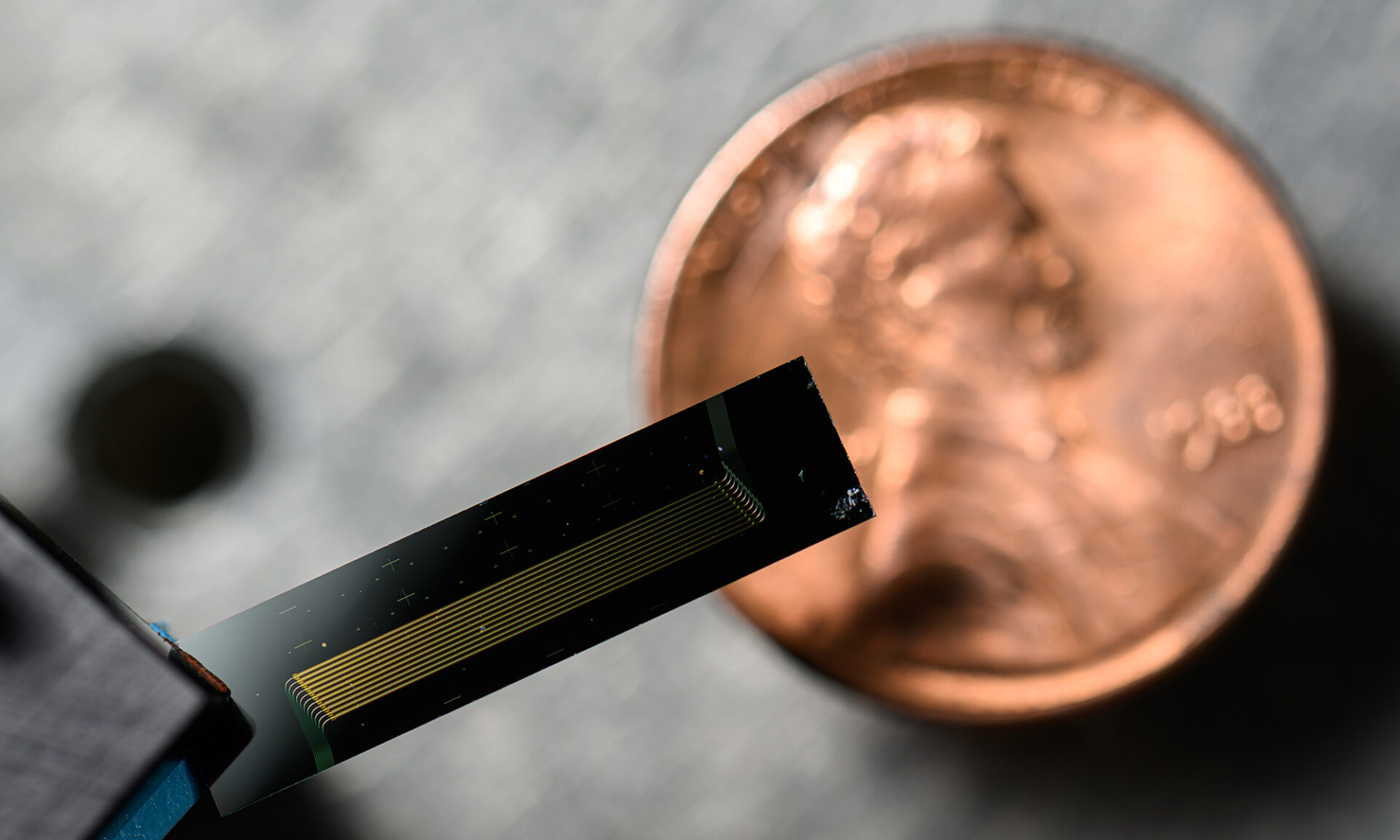
2025-06-11 アメリカ合衆国・コロラド大学ボールダー校(CU Boulder)
<関連情報>
- https://www.colorado.edu/today/2025/06/11/new-quantum-navigation-device-uses-atoms-measure-acceleration-3d
- https://www.science.org/doi/full/10.1126/sciadv.adt7480
光格子におけるベクトル原子加速度計測 Vector atom accelerometry in an optical lattice
Catie LeDesma, Kendall Mehling, and Murray Holland
Science Advances Published:4 Jun 2025
DOI:https://doi.org/10.1126/sciadv.adt7480

Abstract
Two kinds of multidimensional atom interferometers are demonstrated that are capable of measuring both the magnitude and direction of applied inertial forces. These interferometers, built from ultracold Bose-Einstein condensed rubidium atoms, use an original design that operates entirely within the Bloch bands of an optical lattice. Through time-dependent lattice position control, we realize Bloch oscillations in two dimensions and a vector atomic Michelson interferometer. Fits to the observed Bloch oscillations demonstrate the measurement of an applied acceleration of 2g along two axes, where g is Earth’s gravitational acceleration. For the Michelson interferometer, we perform Bayesian inferencing from a 49-channel output by repeating experiments for two-axis accelerations and demonstrate vector parameter estimation. Accelerations can be measured from single experimental runs and do not require repeated shots to construct a fringe. The performance of our device is near the quantum limit for the interferometer size and quantum detection efficiency of the atoms.