2025-08-27 英国研究イノベーション機構(UKRI)
<関連情報>
- https://www.ukri.org/news/james-webb-space-telescope-reveals-cosmic-butterflys-hidden-secrets/
- https://academic.oup.com/mnras/article/542/2/1287/8241385
JWST/MIRIによる惑星状星雲NGC 6302の観測-I. PAH形成を引き起こす紫外線照射トーラスと高温バブル The JWST/MIRI view of the planetary nebula NGC 6302 – I. A UV-irradiated torus and a hot bubble triggering PAH formation
Mikako Matsuura , Kevin Volk , Patrick Kavanagh , Bruce Balick , Roger Wesson , Albert A Zijlstra , Harriet L Dinerstein , Els Peeters , N C Sterling , Jan Cami …
Monthly Notices of the Royal Astronomical Society Published:27 August 2025
DOI:https://doi.org/10.1093/mnras/staf1194
ABSTRACT
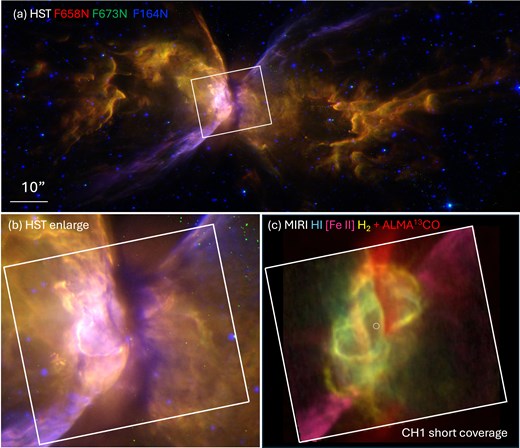
NGC 6302 is a spectacular bipolar planetary nebula (PN) whose spectrum exhibits fast outflows and highly ionized emission lines, indicating the presence of a very hot central star (~220 000 K). Its infrared spectrum reveals a mixed oxygen and carbon dust chemistry, displaying both silicate and polycyclic aromatic hydrocarbon (PAH) features. Using the James Webb Space Telescope Mid-Infrared Instrument and Medium Resolution Spectrometer, a mosaic map was obtained over the core of NGC 6302, covering the wavelength range of 5–28 μm and spanning an area of ~18.5 arcsec × 15arcsec. The spatially resolved spectrum reveals ~200 molecular and ionized lines from species requiring ionization potentials of up to 205 eV. The spatial distributions highlight a complex structure at the nebula’s centre. Highly ionized species such as [Mg vii] and [Si vii] show compact structures, while lower ionization species such as H+ extend much farther outwards, forming filament-defined rims that delineate a bubble. Within the bubble, the H+ and H2 emission coincide, while the PAH emission appears farther out, indicating an ionization structure distinct from typical photodissociation regions, such as the Orion Bar. This may be the first identification of a PAH formation site in a PN. This PN appears to be shaped not by a steady, continuous outflow, but by a series of dynamic, impulsive bubble ejections, creating local conditions conducive to PAH formation. A dusty torus surrounds the core, primarily composed of large (m-sized) silicate grains with crystalline components. The long-lived torus contains a substantial mass of material, which could support an equilibrium chemistry and a slow dust-formation process.