2025-08-25 物質・材料研究機構
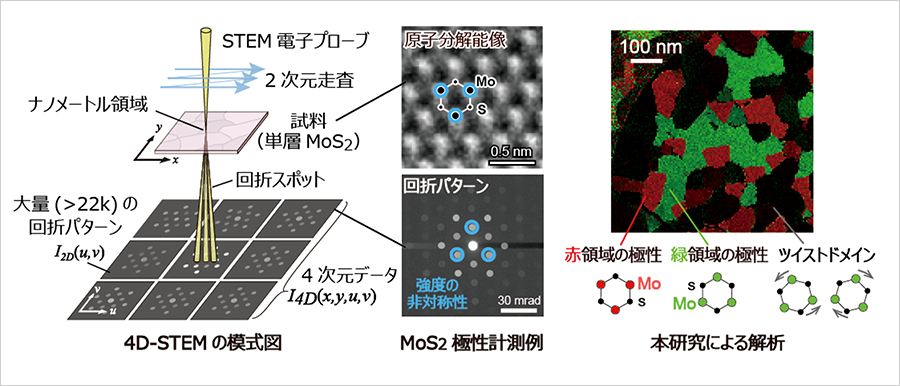
図: 4D-STEMと呼ばれる計測法の模式図(xy座標は位置情報、uv座標は回折パターン情報を表している)とMoS2の原子配列観察例、および本研究により一つのツイストドメインの極性を赤と緑で色分けした解析結果
<関連情報>
- https://www.nims.go.jp/press/2025/08/202508250.html
- https://www.nims.go.jp/press/2025/08/vci16p000000d4pu-att/202508250.pdf
- https://onlinelibrary.wiley.com/doi/10.1002/smtd.202501065
4D-STEMと非監督型機械学習を用いて、単層MoS2におけるツイストドメインを解明する Unveiling Twist Domains in Monolayer MoS2 through 4D-STEM and Unsupervised Machine Learning
Koji Kimoto, Ovidiu Cretu, Koji Harano, Fumihiko Uesugi, Jun Kikkawa, Kohei Aso, Yoshifumi Oshima, Takashi Matsumoto, Yoshiki Sakuma
Small Methods Published: 06 August 2025
DOI:https://doi.org/10.1002/smtd.202501065
Abstract
Dichalcogenides, such as molybdenum disulfide (MoS2), are being studied extensively due to their 2D feature and various material properties. Although crystal structures are critical for applications, conventional atomic structure analyses have a limited field of view. In this study, the crystal domains of monolayer MoS2 synthesized by metal–organic chemical vapor deposition (MOCVD) are analyzed using 4D scanning transmission electron microscopy (STEM) and unsupervised machine learning. Twist domains (±11°) are identified through the nonnegative matrix factorization (NMF) and hierarchical clustering of numerous (>22k) diffraction patterns from a wide field of view. Preprocessing for detecting noncentrosymmetry effectively visualizes the polarities of distinct MoS2 domains by highlighting the violation of Friedel’s law in diffraction physics. Analyses reveal that the specimen deposited on Al2O3 (0001) at 850 °C consists of domains measuring ≈100 nm in size and featuring many mirror-twin boundaries. The findings provide valuable insights into optimizing the MOCVD process and elucidating crystal growth mechanisms.