2025-08-25 ハーバード大学
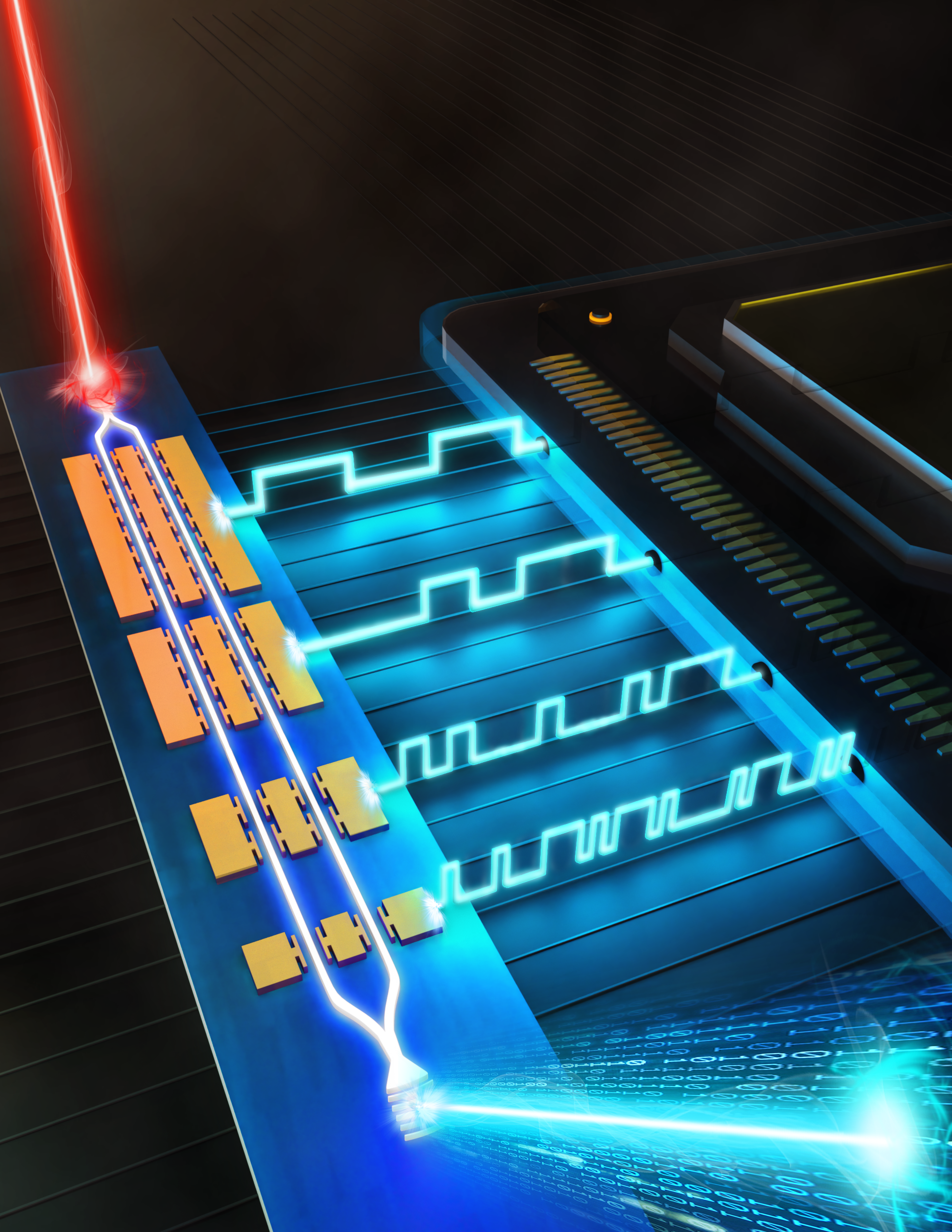
An artist’s illustration of the electro-optic digital-to-analog converter, depicting high-speed information transfer between electronics and optics. Credit: Second Bay Studios
<関連情報>
- https://seas.harvard.edu/news/2025/08/digital-analog-one-smooth-step
- https://www.nature.com/articles/s41566-025-01719-9
効率的な計算と任意波形生成のための統合型電気光学デジタル-アナログ変換リンク Integrated electro-optic digital-to-analogue link for efficient computing and arbitrary waveform generation
Yunxiang Song,Yaowen Hu,Xinrui Zhu,Keith Powell,Letícia Magalhães,Fan Ye,Hana K. Warner,Shengyuan Lu,Xudong Li,Dylan Renaud,Norman Lippok,Di Zhu,Benjamin Vakoc,Mian Zhang,Neil Sinclair & Marko Lončar
Nature Photonics Published:25 August 2025
DOI:https://doi.org/10.1038/s41566-025-01719-9
Abstract
The rapid growth in artificial intelligence and modern communication systems demands innovative solutions for increased computational power and advanced signalling capabilities. Integrated photonics, leveraging the analogue nature of electromagnetic waves at the chip scale, offers a promising complement to approaches based on digital electronics. To fully unlock their potential as analogue processors, establishing a common technological base between conventional digital electronics and analogue photonics is imperative for building next-generation computing and communications systems. However, the absence of an efficient interface has thus far critically challenged a comprehensive demonstration of the advantages of analogue photonic hardware, with the scalability, speed and energy consumption as primary bottlenecks. Here we address this challenge and demonstrate a general electro-optic digital-to-analogue link enabled using foundry-based lithium niobate nanophotonics. Using purely digital electronic inputs, we achieve the on-demand generation of both analogue optical and electronic waveforms at information rates of up to 186 Gb s−1. The optical waveforms address the digital-to-analogue electro-optic conversion challenge in photonic computing, showcasing high-fidelity Modified National Institute of Standards and Technology image encoding with an ultralow power consumption of 0.058 pJ b−1. The electronic waveforms enable a pulse-shaping-free microwave arbitrary waveform generation method with ultrabroadband tunable delay and gain. Our results pave the way for efficient and compact digital-to-analogue conversion paradigms enabled by integrated photonics, and underscore the transformative impact that analogue photonic hardware may have on various applications, such as computing, optical interconnects and high-speed ranging.