2025-08-22 京都大学
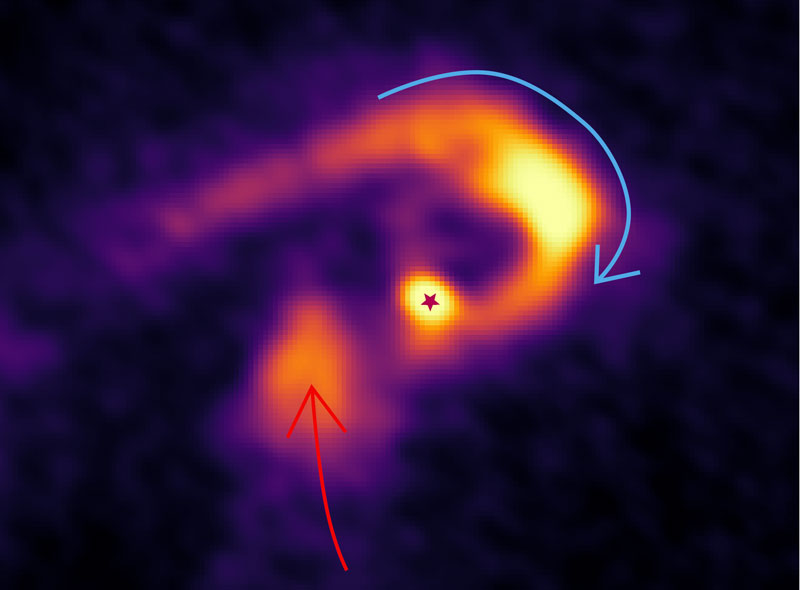
大質量星形成領域 G336.018-00.82における、星間塵から放射される電波の強度分布。星型のマークは原始星の位置を示す。赤と青の矢印に沿って、ガスが回転しながら落下している。青の矢印が示すガス流(ストリーマ)は、分子雲コアから原始星近傍の高密度領域まで、物質を輸送する役割を担う。(credit: Fernando Olguin)
<関連情報>
- https://www.kyoto-u.ac.jp/ja/research-news/2025-08-22-1
- https://www.kyoto-u.ac.jp/sites/default/files/2025-08/2508_SciAdv_Olguin_relj%20web-0c9e2bb618d1df57a874fee519eba3a2.pdf
- https://www.science.org/doi/10.1126/sciadv.adw4512
大規模な延長ストリームが質量の大きな若い恒星に栄養を供給する Massive extended streamers feed high-mass young stars
Fernando A. Olguin, Patricio Sanhueza, Adam Ginsburg, Huei-Ru Vivien Chen, […] , and Andrés E. Guzmán
Science Advances Published:20 Aug 2025
DOI:https://doi.org/10.1126/sciadv.adw4512
Abstract
Stars are born in a variety of environments that determine how they gather gas to achieve their final masses. It is generally believed that disks are ubiquitous around protostars as a result of angular momentum conservation and are natural places to grow planets. As such, they are proposed to be the last link in the inflow chain from the molecular cloud to the star. However, disks are not the only form that inflows can take. Here, we report on high-resolution observations performed with the Atacama Large Millimeter/submillimeter Array that reveal inflows in the form of streamers. These streamers persist well within the expected disk radius, indicating that they play a substitute role channeling material from the envelope directly to an unresolved small disk or even directly to the forming high-mass protostar. These flows are massive enough to feed the central unresolved region at a rate suf ficient to quench the feedback effects of the young massive star.