
2025-08-21 カリフォルニア大学リバーサイド校(UCR)
<関連情報>
- https://news.ucr.edu/articles/2025/08/21/using-exoplanets-study-dark-matter
- https://journals.aps.org/prd/abstract/10.1103/qkwt-kd9q
系外惑星を用いて超重暗黒物質を調査する Probing superheavy dark matter with exoplanets
Mehrdad Phoroutan-Mehr and Tara Fetherolf
Physical Review D Published: 20 August, 2025
DOI: https://doi.org/10.1103/qkwt-kd9q
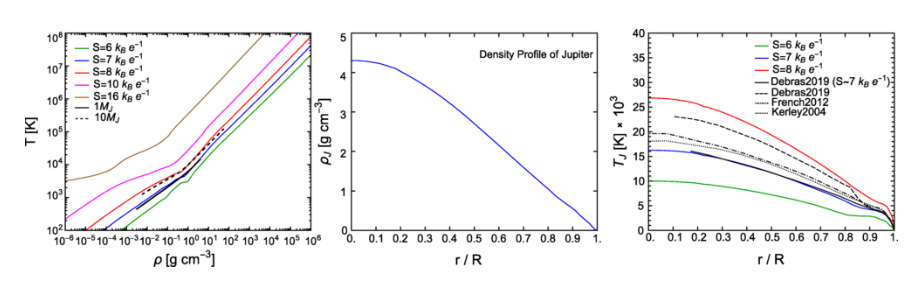
Abstract
Exoplanets, with their large volumes and low temperatures, are ideal celestial detectors for probing dark matter (DM) interactions. DM particles can lose energy through scattering with the planetary interior and become gravitationally captured if their interaction with the visible sector is sufficiently strong. In the absence of annihilation, the captured DM thermalizes and accumulates at the planet’s center, eventually collapsing into black holes (BHs). Using gaseous exoplanets as an example, we demonstrate that BH formation can occur within an observable timescale for superheavy DM with masses greater than 106 GeV and nuclear scattering cross sections. The BHs may either accrete the planetary medium or evaporate via Hawking radiation, depending on the mass of the DM that formed them. We explore the possibility of periodic BH formation within the unconstrained DM parameter space and discuss potential detection methods, including observations of planetary-mass objects, pulsed high-energy cosmic rays, and variations in exoplanet temperatures. Our findings suggest that future extensive exoplanet observations could provide complementary opportunities to terrestrial and cosmological searches for superheavy DM.


