
2025-08-20 横浜国立大学
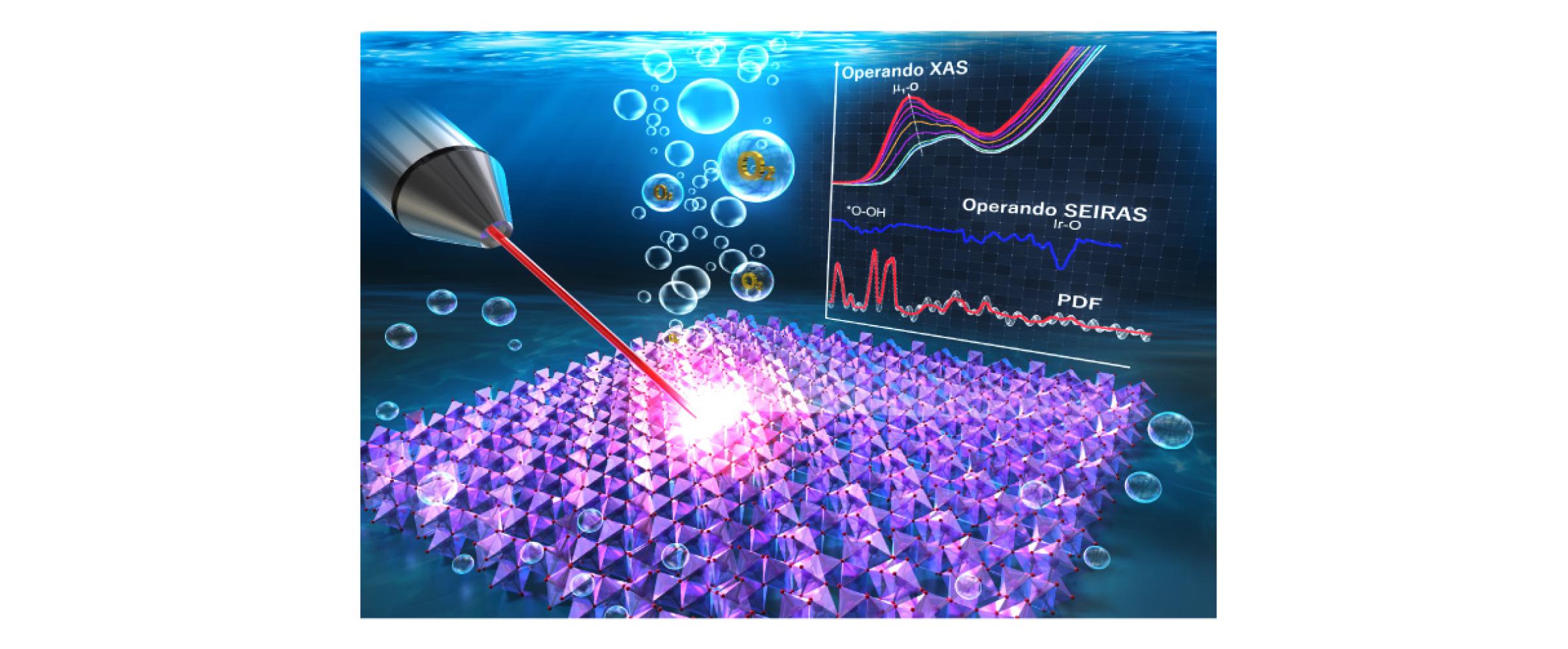
図:本研究の概要図。電位を印加した状態、つまり、水電解が起こっている際の酸化イリジウム表面の構造をX線によってマルチモーダルに分析する様子を表現している。
<関連情報>
- https://www.ynu.ac.jp/hus/koho/33936/detail.html
- https://www.ynu.ac.jp/hus/koho/33936/34_33936_1_1_250820083109.pdf
- https://pubs.acs.org/doi/10.1021/jacs.4c18510
OER用IrOx触媒の活性サイトの同定:オペランドXAS、SEIRAS、および理論的研究の組み合わせによる研究 Identifying Active Sites of IrOx Catalysts for OER: A Combined Operando XAS, SEIRAS, and Theoretical Study
Neha Thakur,Yadan Ren,Mukesh Kumar,Tomoki Uchiyama,Mitsuharu Fujita,Ikkei Arima,Minoru Ishida,Yingkai Wu,Yuta Tsuji,Hideto Imai,Masashi Matsumoto,Yu Zhuang,Kentaro Yamamoto,Toshiyuki Matsunaga,Koji Ohara,Mitsuhiro Matsumoto,Yuki Orikasa,Yoshiyuki Kuroda,Shigenori Mitsushima,and Yoshiharu Uchimoto
Journal of the American Chemical Society Published: August 19, 2025
DOI:https://doi.org/10.1021/jacs.4c18510
Abstract
Iridium oxide is a benchmark catalyst for anodic oxygen evolution reactions due to its high activity and durability. However, debates persist regarding the short lifespan of reaction intermediates and whether amorphous phases exhibit higher activity in comparison to crystalline ones. Herein, we examined IrOx catalysts with different degrees of crystallinity (SA3.5, SA58, SA103, and SA14.6, named after their BET surface area) and revealed the relation between their structures and OER activities. The atomic pair distribution function analyses show that the amorphous IrOx (SA3.5, SA103, and SA14.6) possesses monoclinic and orthorhombic-like structural phases or motifs, which differ from the typical tetragonal symmetry of crystalline IrO2. Operando X-ray absorption spectroscopy (XAS) and operando surface-enhanced infrared absorption spectroscopy (SEIRAS) revealed that the SA3.5 sample, with higher monoclinic content, exhibits a structure containing corner- and edge-sharing octahedra with highly undercoordinated sites, leading to structural defects. These defects generate active electrophilic OI– species, facilitating the generation of *OOH intermediates and enhancing OER activity. Theoretical studies reveal that they also lower the energy barrier for the monoclinic crystal structure. These findings offer a fundamental understanding of amorphous iridium oxides and provide inspiration for developing new OER catalysts.


