2025-08-07 名古屋大学
<関連情報>
- https://www.nagoya-u.ac.jp/researchinfo/result/2025/08/post-858.html
- https://www.nagoya-u.ac.jp/researchinfo/result/upload_images/20250807_isee.pdf
- https://www.nature.com/articles/s41467-025-61919-3
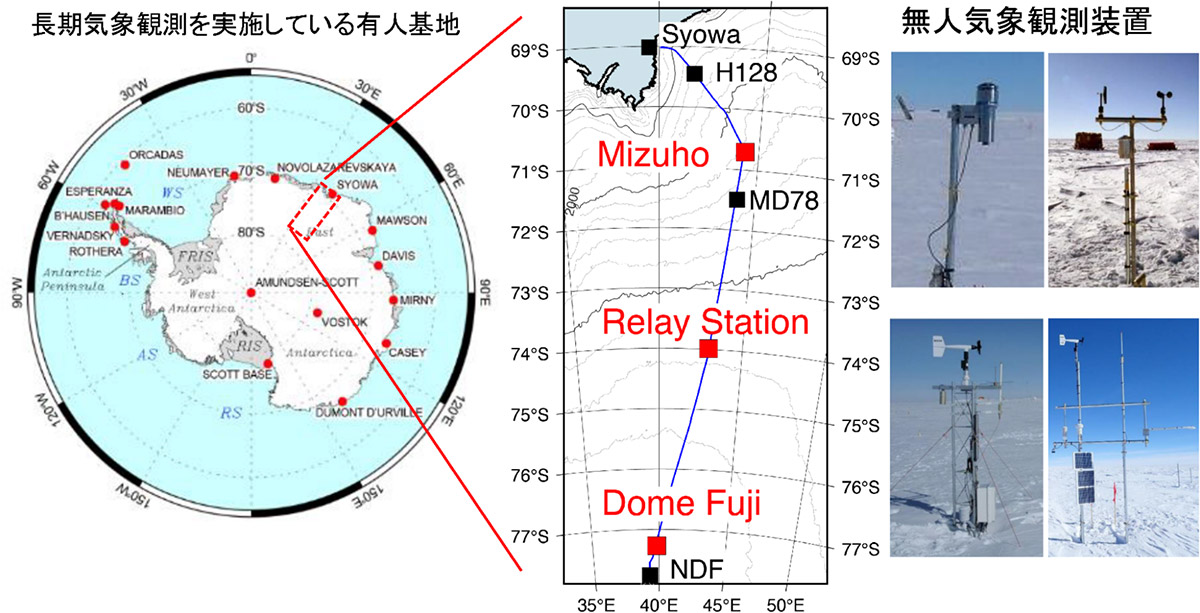
南インド洋の温暖化により引き起こされた東南極内陸部の夏季温暖化 Summer warming in the East Antarctic interior triggered by southern Indian Ocean warming
Naoyuki Kurita,David H. Bromwich,Takao Kameda,Hideaki Motoyama,Naohiko Hirasawa,David E. Mikolajczyk,Linda M. Keller & Matthew A. Lazzara
Nature Communications Published:22 July 2025
DOI:https://doi.org/10.1038/s41467-025-61919-3
Abstract
The effects of global warming on Antarctica’s interior, which is covered by a huge ice sheet, remain uncertain. A major reason for this is the lack of long-term observations of near-surface temperatures in the interior region, compounded by significant gaps in the available dataset. Here, we present a complete temperature record from three inland stations (Mizuho, Relay Station, and Dome Fuji), where gaps have been filled with corrected reanalysis data. At all stations, the record revealed a statistically significant warming in annual mean temperature from 1993 to 2022, with the most rapid warming occurring during the half-year mean from October to March. At the same time, a rapid warming of sea surface temperature (SST) in the southern Indian Ocean strengthened the SST fronts over the Subtropical Frontal Zone (STFZ), resulting in a meridional dipole response in the atmosphere and an increased advection of warm air into the interior of the East Antarctic Ice Sheet (EAIS). Over the past 30 years, the SST gradient in the STFZ has increased by around 20%, making the occurrence of the meridional dipole pattern more likely. Consequently, the climate of Antarctica’s interior is susceptible to the impact of climate change in the southern Indian Ocean.