
2025-07-30 東京科学大学
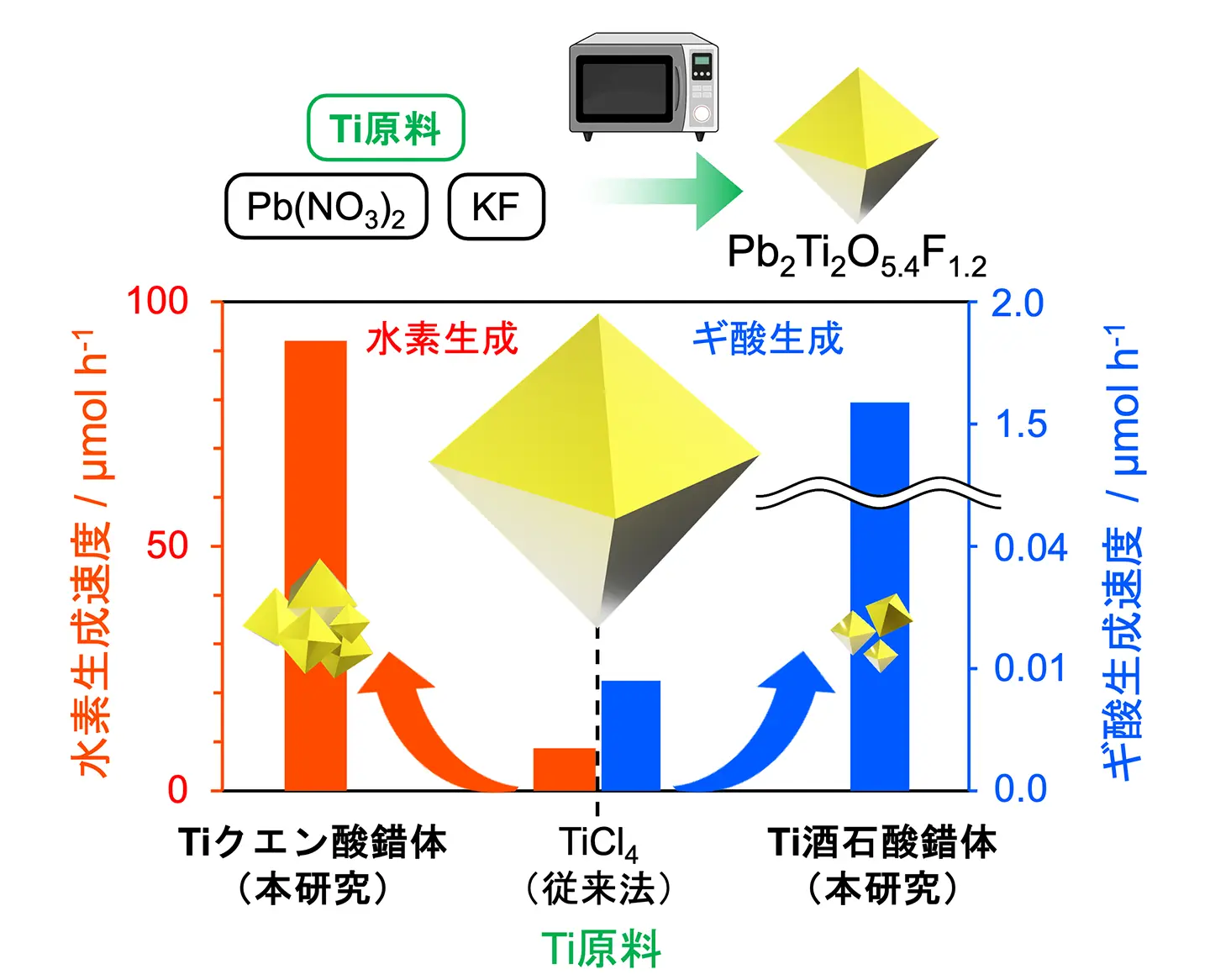 酸フッ化物光触媒のナノ粒子化による性能向上を示したデザインイラスト。
<関連情報>
- https://www.isct.ac.jp/ja/news/a8olayqt2ux3
- https://www.isct.ac.jp/plugins/cms/component_download_file.php?type=2&pageId=&contentsId=1&contentsDataId=2028&prevId=&key=3dfd8237c60f4847b76989ebcd021e81.pdf
- https://pubs.acs.org/doi/10.1021/acscatal.5c02229
可視光線による水素生成と二酸化炭素還元において改善された光触媒活性を示すメソポーラスオキシハロイド集合体 Mesoporous Oxyhalide Aggregates Exhibiting Improved Photocatalytic Activity for Visible-Light H2 Evolution and CO2 Reduction
Hiroto Ueki,Toshiya Tanaka,Shuji Anabuki,Ryuichi Nakada,Megumi Okazaki,Kenta Aihara,Masashi Hattori,Fumitaka Ishiwari,Rie Haruki,Shunsuke Nozawa,Toshiyuki Yokoi,Michikazu Hara,Osamu Ishitani,Akinori Saeki,Akira Yamakata,and Kazuhiko Maeda
ACS Catalysis Published July 9, 2025
DOI:https://doi.org/10.1021/acscatal.5c02229
Abstract
Oxyhalides are promising visible-light photocatalysts for water splitting and CO2 conversion; however, those exhibiting high activity for these reactions have rarely been reported. Here, we show that using water-soluble Ti complexes as precursors in the microwave-assisted hydrothermal synthesis of the oxyhalide photocatalyst Pb2Ti2O5.4F1.2 (PTOF) resulted in the production of nanoparticulate PTOF. The primary particle size of the synthesized PTOF ranged from several tens of nanometers to several hundreds of nanometers. Using Ti-citric acid or Ti-tartaric acid complexes as precursors, the PTOF was formed as mesoporous aggregates, compared with a bulky analogue (0.5–1 μm) prepared using a TiCl4 precursor. The PTOF prepared from Ti-citric acid complex had a particle size of 50–100 nm and showed a one-order-of-magnitude greater activity for H2 evolution from an aqueous ethylenediaminetetraacetic acid solution with the aid of a Rh cocatalyst. An apparent quantum yield (AQY) of 15.4 ± 1.0% at 420 nm, which is the highest among the reported oxyhalide photocatalysts, was achieved under optimal conditions. Although excess particle size reduction of PTOF lowered the H2 evolution activity, the PTOF with the smallest possible primary particle size of 15–30 nm, prepared from Ti-tartaric acid complex, showed the highest activity toward the selective reduction of CO2 into formate in a nonaqueous environment when combined with a binuclear Ru(II) complex. The CO2 reduction AQY was 10.4 ± 1.8% at 420 nm, a record-high value among metal-complex/semiconductor binary hybrid photocatalysts. This study highlights the importance of morphological control of oxyhalides for realizing their full potential as photocatalysts for artificial photosynthesis.


