2025-07-24 ハーバード大学
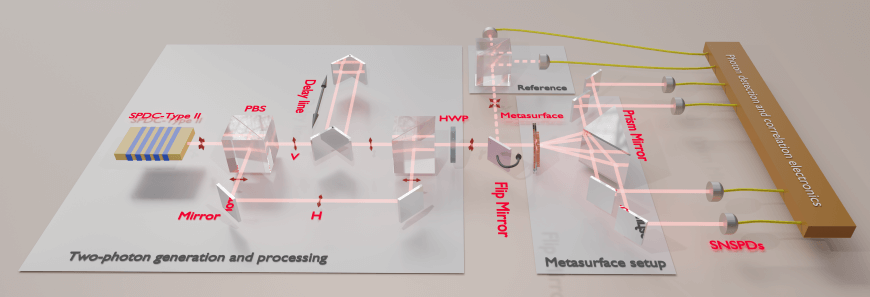
Schematic depiction of metasurface-based optical setup in the lab.
<関連情報>
- https://seas.harvard.edu/news/2025/07/could-metasurfaces-be-next-quantum-information-processors
- https://www.science.org/doi/10.1126/science.adw8404
一般化されたホン・ウー・マンデル干渉のためのメタサーフェス量子グラフ Metasurface quantum graphs for generalized Hong-Ou-Mandel interference
Kerolos M. A. Yousef, Marco D’Alessandro, Matthew Yeh, Neil Sinclair, […] , and Federico Capasso
Science Published:24 Jul 2025
DOI:https://doi.org/10.1126/science.adw8404
Editor’s summary
The bunching and antibunching of interfering single photons is a fundamental quantum effect that underpins the development of optical-based quantum computing and communication. Extending this Hong-Ou-Mandel (HOM) effect to larger systems requires an increasing number of bulky optical components that would be practically infeasible. Yousef et al. report on the use of metasurfaces as a multiport HOM interferometer and related quantum correlation measurements (see the Perspective by Shcherbakov). They also introduce a graph-theoretic formalism that represents both metasurface-based quantum optics and the resulting nonclassical correlation landscape. Such graphs can be used for the design of scalable, low-decoherence quantum information infrastructures. —Ian S. Osborne
Abstract
Multiphoton interference and entanglement are fundamental to quantum information science, yet extending these effects to higher-dimensional systems remains challenging given the imperfections and complexity of scaling conventional linear-optical setups. We present a generalized Hong-Ou-Mandel effect using metasurfaces and graph theory, achieving controlled multiphoton bunching, antibunching, and entanglement across parallel Jones matrix–encoded spatial modes—all within a single-layer metasurface. A graph-theoretic dual framework is introduced that simultaneously encodes the metasurface-based multiport interferometer designs and its resulting nonclassical correlations, enabling the direct translation of linear quantum optical networks into a single-layer metasurface. We also demonstrate the ability of metasurfaces to produce multipath-entangled states and perform transformations equivalent to higher-order Hadamard interferometers. Our results underscore metasurface quantum graphs for scalable, low-decoherence quantum information infrastructure.