2025-07-22 ペンシルベニア州立大学(Penn State)
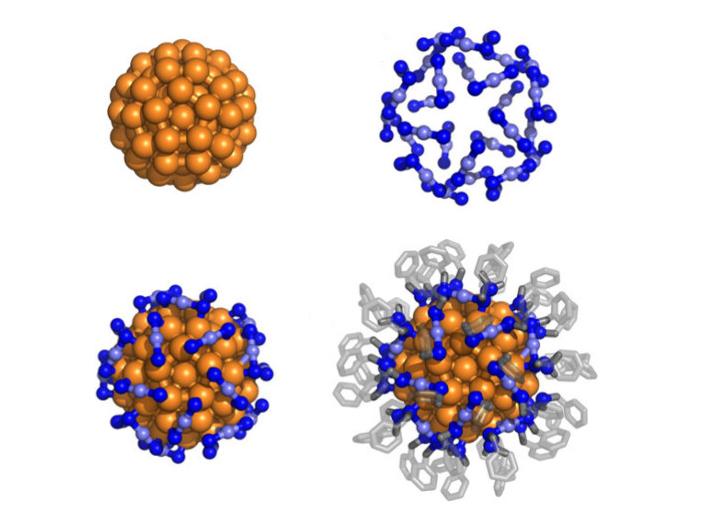
New research shows how gold clusters mimic the key properties of the most accurate systems currently used in quantum applications, showing promise for a tunable, scalable option for quantum devices. The cluster contains a gold core, on top left, as well as ligands, on the bottom right. Credit: Knappenberger Lab / Penn State. All Rights Reserved.
<関連情報>
- https://www.psu.edu/news/eberly-college-science/story/gold-clusters-show-promise-scalable-options-quantum-computers-sensors
- https://pubs.acs.org/doi/10.1021/acscentsci.5c00139
- https://pubs.acs.org/doi/10.1021/acs.jpclett.5c00723
Au144(SC8H9)60クラスターの多様な超原子磁気・スピン特性 Diverse Superatomic Magnetic and Spin Properties of Au144(SC8H9)60 Clusters
Juniper Foxley,Marcus Tofanelli,Jane A. Knappenberger,Christopher J. Ackerson,and Kenneth L. Knappenberger Jr.
ACS Central Science Published: May 29, 2025
DOI:https://doi.org/10.1021/acscentsci.5c00139
Abstract
Au144(SC8H9)60, a colloidal cluster with a 1.7 nm inorganic diameter, exhibits both metallic and molecular-like behavior, along with a distribution of unfilled superatom states. Its 1.7–2.5 eV electronic transitions were probed with variable-temperature, variable-field magnetic circular dichroism (VTV⎯⇀-MCD), revealing two energy regions with distinct responses. Below 2.0 eV, MCD transitions exhibited diverse VTV⎯⇀ responses, including both paramagnetic and diamagnetic behavior, implicating multiple nondegenerate initial states originating within the open-shell superatom S, D, and H HOMO manifold. Above 2.0 eV, uniform field-dependent responses suggested spin-vibronic coupling due to metal–ligand mixing. The Au144(SC8H9)60 magneto-optical response is surprisingly complex given the system’s high electronic-state density; discrete structural domains of the cluster, including the superatomic metal core, likely contribute to this diversity. These results show the potential to investigate and tailor the magneto-optical and spin properties of these clusters through structurally precise synthesis and also identify superatomic colloids as candidates for advancing spin-based technologies.
Au25(SR)18スピン偏極発光におけるパッシベーション配位子の同一性の影響 The Influence of Passivating Ligand Identity on Au25(SR)18 Spin-Polarized Emission
Nathanael L. Smith,Patrick J. Herbert,Marcus A. Tofanelli,Jane A. Knappenberger,Christopher J. Ackerson,and Kenneth L. Knappenberger Jr.
The Journal of Physical Chemistry Letters Published: May 15, 2025
DOI:https://doi.org/10.1021/acs.jpclett.5c00723
Abstract
Magnetic circular photoluminescence (MCPL) spectra were collected following 3.1 eV excitation of two ligand-passivated Au25(SR)18 monolayer-protected clusters (MPCs). Both clusters generated spin-polarized emission; however, the degree of circular polarization noted for Au25(SC8H9)18, which was passivated with the aromatic phenylethanethiol ligand, was 5× that obtained for Au25(SC3)18, whose passivating ligand was aliphatic. Variable-magnetic field data were analyzed to determine Landé g-factors and spectroscopic term symbols for observable transitions contributing to the clusters’ MCPL spectra. For Au25(PET)18, transitions originated from one doublet and two quartet fine-structure superatomic electronic states; by comparison, the Au25(SC3)18 spectrum contained only two components, both of which arose from doublet superatomic electronic states. Additionally, Faraday B-term contributions, which report on field-induced mixing, were more pronounced for Au25(SC3)18 spectral components. Therefore, the decreased spin-polarized emission by Au25(SC3)18 was attributed to stronger coupling to nonradiative decay channels. These results suggest the Au25(SR)18 cluster’s passivating ligand can be used to tune the relative populations of emissive fine-structure states, the extent of mixing between radiative and nonradiative states, and the amplitude of spin-polarized emission in MPCs.