2025-07-14 中国科学院(CAS)
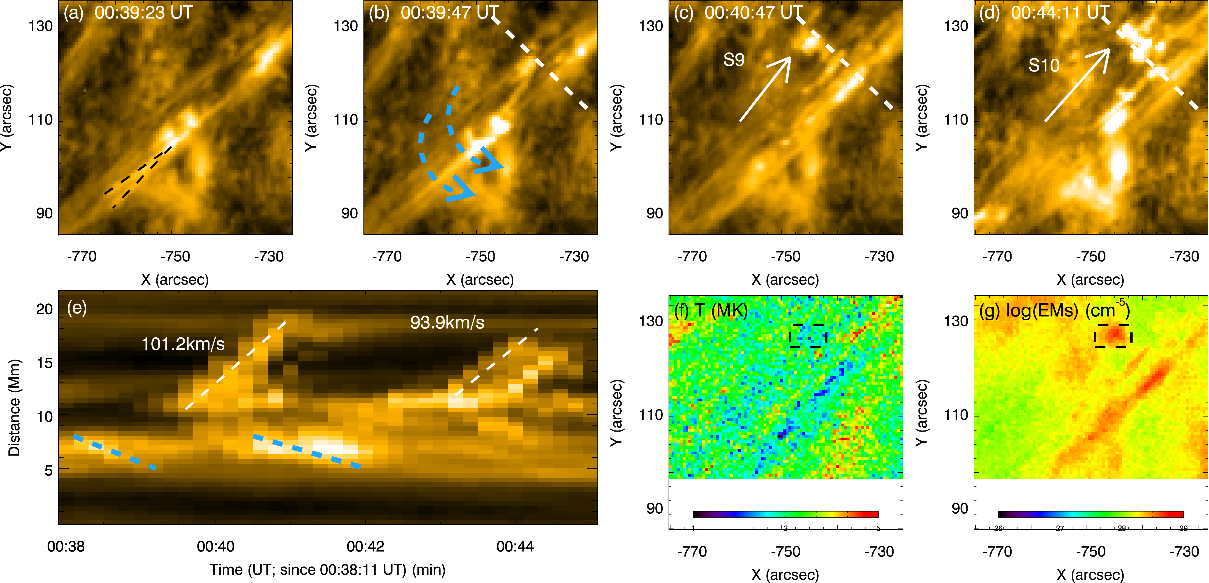
The black dashed lines in panel (a) show the brightening threads within the filament that feature a small-angle misalignment. The panels (b)-(d) show the two subsequent small-scale vertical jets. The panel (e) shows the distance-time plot made along the jet. The panels (f)-(g) show the results of the DEM analysis for the small jet S9. (Image by LIU Dongxu)
<関連情報>
- https://english.cas.cn/newsroom/research_news/phys/202507/t20250715_1047362.shtml
- https://iopscience.iop.org/article/10.3847/2041-8213/addfca
成分磁気リコネクションによるダブルデッカーフィラメントの形成とダイナミクスの解読 Deciphering the Formation and Dynamics of Double-decker Filaments through Component Magnetic Reconnection
Dongxu Liu, Yuandeng Shen, Yi Bi, Zehao Tang, Chengrui Zhou, and Surui Yao
The Astrophysical Journal Letters Published: 2025 June 24
DOI:10.3847/2041-8213/addfca
Abstract
The formation of double-decker filaments has long been an enigma in the field of solar physics. Using stereoscopic observations from the Solar Dynamics Observatory and the Solar Terrestrial Relations Observatory, we show that the double-decker filament formed on 2013 August 30 resulted from the splitting of a braided magnetic flux rope. The splitting was driven by component magnetic reconnection between intertwined field lines, triggered by the rotational motion in a part of one filament footpoint. This mechanism, inferred from observed small jets, brightenings, and bidirectional mass flows, differs from the previous conclusion attributing filament splitting to magnetic reconnection between the legs of confining magnetic field lines within or above the filament. The splitting speed might be modulated by the reconnection speed, as evidenced by the correspondence between the filament’s slow and fast rising phases and the intermittent and violent brightening stages. Following the splitting, the upper branch of the double-decker filament erupted as a coronal mass ejection, giving rise to a GOES soft X-ray M1.2 flare. In conclusion, our observations present a new formation mechanism for double-decker filaments, and the subsequent partial eruption is likely attributable to the torus instability of the background coronal magnetic field. Moreover, the detection of small jets within the filament provides new insights into the role of component magnetic reconnection in localized coronal heating processes.