
2025-07-02 バーミンガム大学
<関連情報>
- https://www.birmingham.ac.uk/news/2025/young-forests-could-help-to-capture-carbon-in-climate-change-fight
- https://www.nature.com/articles/s41558-025-02355-5
最適な炭素除去のために若い二次林を保護する Protect young secondary forests for optimum carbon removal
Nathaniel Robinson,C. Ronnie Drever,David A. Gibbs,Kristine Lister,Adriane Esquivel-Muelbert,Viola Heinrich,Philippe Ciais,Celso H. L. Silva-Junior,Zhihua Liu,Thomas A. M. Pugh,Sassan Saatchi,Yidi Xu & Susan C. Cook-Patton
Nature Climate Change Published:24 June 2025
DOI:https://doi.org/10.1038/s41558-025-02355-5
Abstract
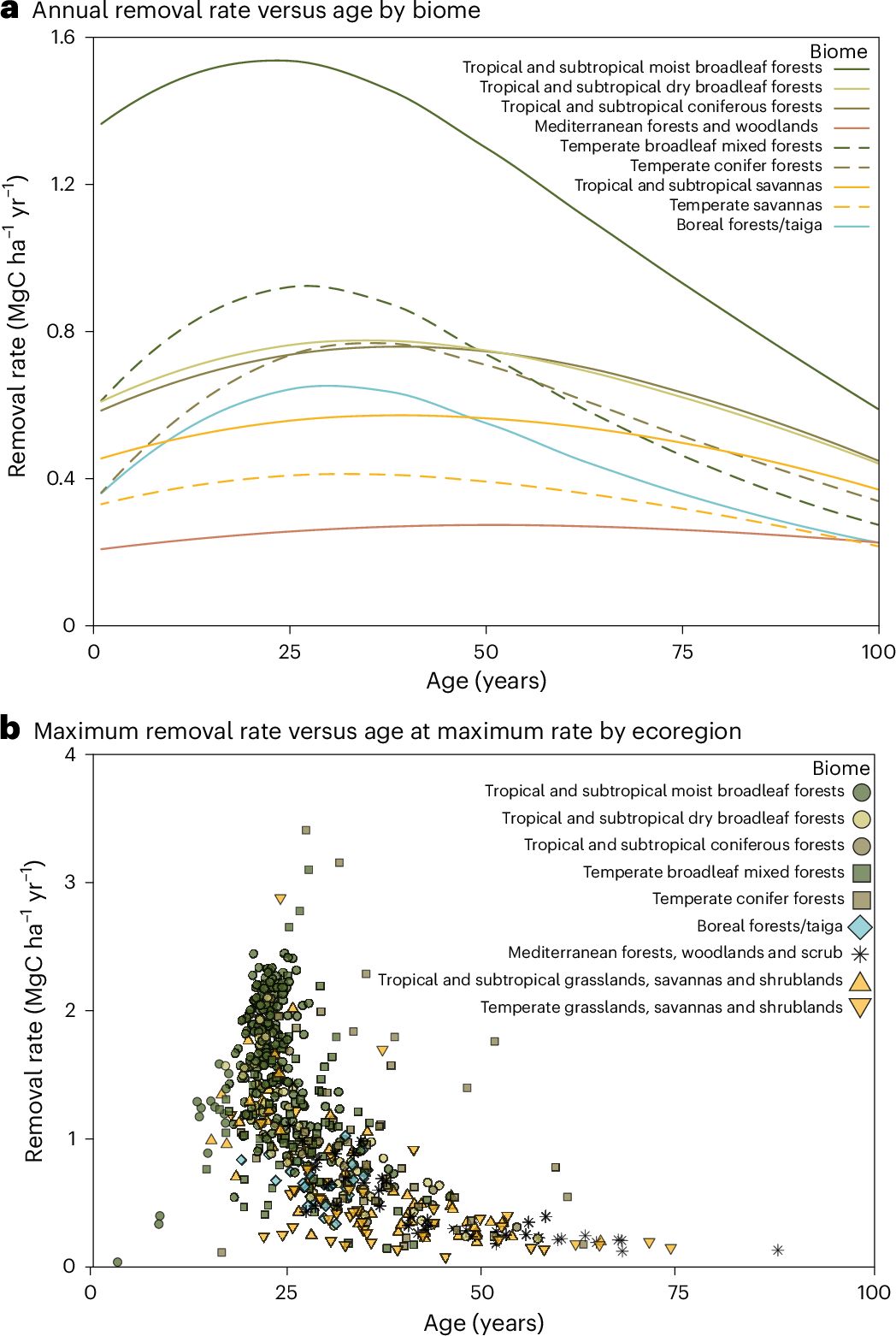
Avoiding severe global warming requires large-scale removals of atmospheric carbon dioxide. Forest regeneration offers cost-effective carbon removals, but annual rates vary substantially by location and forest age. Here we generate grid-level (~1-km2) growth curves for aboveground live carbon in naturally regrowing forests by combining 109,708 field estimates with 66 environmental covariates. Across the globe and the first 100 years of growth, maximum carbon removal rates varied 200-fold, with the greatest rates estimated in ~20- to 40-year-old forests. Despite a focus on new forests for natural climate solutions, protecting existing young secondary forests can provide up to 8-fold more carbon removal per hectare than new regrowth. These maps could help to target the optimal ages and locations where a key carbon removal strategy could be applied, and improve estimates of how secondary forests contribute to global carbon cycling.


