2025-02-27 清華大学
<関連情報>
- https://www.tsinghua.edu.cn/en/info/1245/14103.htm
- https://academic.oup.com/nsr/article/11/12/nwae417/7905065
水銀の自然記録から、大気沈着量の変化に対する生態系の応答が明らかになる Mercury records from natural archives reveal ecosystem responses to changing atmospheric deposition
Qinqin Chen, Qingru Wu, Yuying Cui, Shuxiao Wang
National Science Review Published:19 November 2024
DOI:https://doi.org/10.1093/nsr/nwae417
ABSTRACT
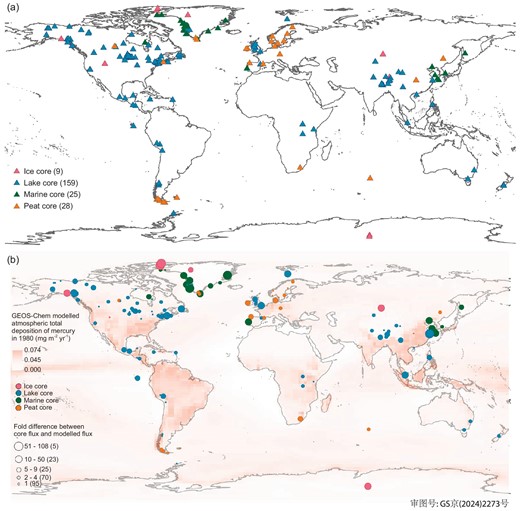
Global ecosystems face mercury contamination, yet long-term data are scarce, hindering understanding of ecosystem responses to atmospheric Hg input changes. To bridge the data gap and assess ecosystem responses, we compiled and compared a mercury accumulation database from peat, lake, ice and marine deposits worldwide with atmospheric mercury deposition modelled by GEOS-Chem, focusing on trends, magnitudes, spatial–temporal distributions and impact factors. The mercury fluxes in all four deposits showed a 5- to 9-fold increase over 1700–2012, with lake and peat mercury fluxes that generally mirrored atmospheric deposition trends. Significant decreases in lake and peat mercury fluxes post-1950 in Europe evidenced effective environmental policies, whereas rises in East Asia, Africa and Oceania highlighted coal-use impacts, inter alia. Conversely, mercury fluxes in marine and high-altitude ecosystems did not align well with atmospheric deposition, emphasizing natural influences over anthropogenic impacts. Our study underscores the importance of these key regions and ecosystems for future mercury management.