2026-11-16 中国科学院(CAS)
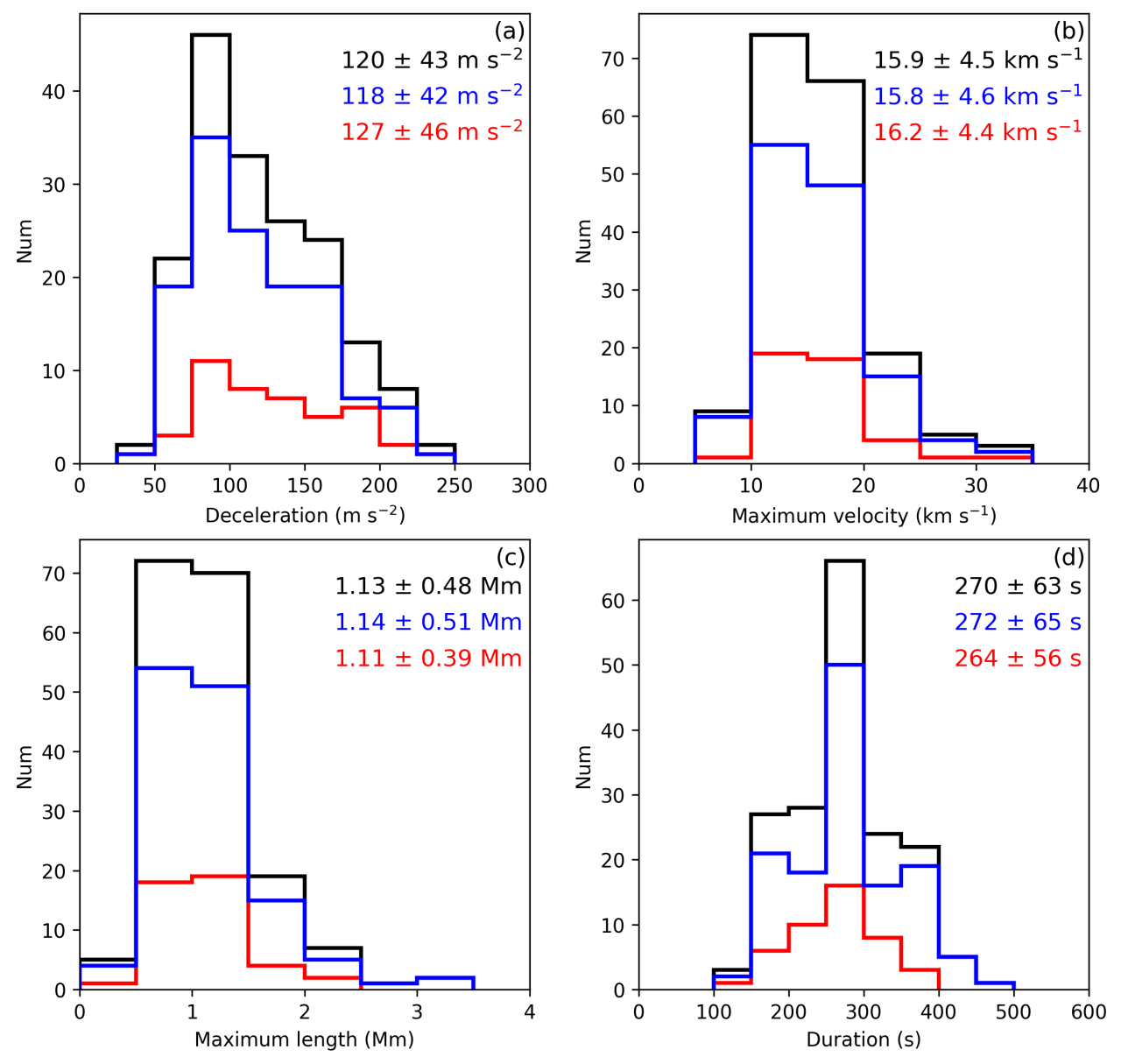
Histograms of the kinematic properties of dynamic fibrils. (Image by WU Guotang)
<関連情報>
- https://english.cas.cn/newsroom/research-news/202611/t20261116_1219218.shtml
- https://iopscience.iop.org/article/10.3847/1538-4357/aeaf54
黒点周辺の動的フィブリルの物理的特性に関する高解像度観測(High-resolution Observations of Physical Properties of Dynamic Fibrils around a Sunspot)
Guotang Wu, Xiaoli Yan, Zhike Xue, Jincheng Wang, Zhe Xu, Liheng Yang, Yadan Duan, Yian Zhou, Xinsheng Zhang, Qifan Dong, and Zongyin WuHide full author list
Published 2026 November 10 • © 2026. The Author(s). Published by the American Astronomical Society.
The Astrophysical Journal, Volume 1012, Number 1
Citation Guotang Wu et al 2026 ApJ 1012 9
DOI 10.3847/1538-4357/aeaf54
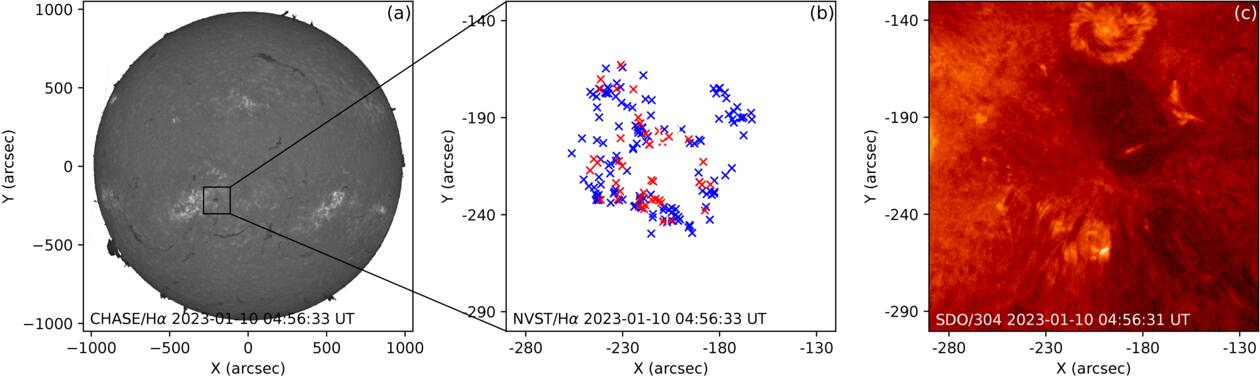
Figure 1. Overview of active region NOAA 13182. (a) Full-disk Hα image from CHASE. The black box marks the field of view of NVST. (b) Hα image from NVST. Blue crosses denote single-parabola events, while red crosses denote multiple-parabola events. The white boxes mark subregions used in subsequent figures. (c) Corresponding 304 Å image from SDO.
出典:Wu et al., The Astrophysical Journal, 1012, 9 (2026). DOI: 10.3847/1538-4357/aeaf54. CC BY 4.0.
太陽の活動領域における彩層では、動的フィブリルと呼ばれる細長いジェット状構造が周期的な上下運動を示す。本研究では、中国科学院雲南天文台の新真空太陽望遠鏡(NVST)によるHα高解像度観測データを用い、2023年1月10日に観測された太陽活動領域NOAA 13182の黒点周辺に存在する176個の動的フィブリルを解析した。さらに、太陽観測衛星SDOの極紫外線画像およびベクトル磁場データを組み合わせ、運動特性と駆動機構を調べた。その結果、132個が単一の放物線状運動、44個が複数の放物線状運動を示し、平均減速度は120±43 m/s²、最大速度は15.9±4.5 km/s、最大長さは1.13±0.48 Mm、持続時間は270±63秒であった。特に、減速度と最大速度には正の相関(ρ=0.71)が認められた。また、黒点半影を伝播する進行性波動との周期の一致や、磁場の傾斜角による運動特性の違いから、動的フィブリルが低速磁気音響波によって駆動される可能性が示された。さらに、彩層から遷移領域、コロナに至る複数の波長帯で対応する構造が確認され、太陽大気におけるエネルギー輸送や加熱への寄与が示唆された。一方、観測の空間・時間分解能や磁場傾斜角の測定精度には限界があり、駆動機構の詳細解明にはさらなる観測が必要である。
Dynamic fibrils are elongated, jet-like structures in the solar chromosphere that exhibit periodic upward and downward motions. In this study, the researchers analyzed 176 dynamic fibrils around the sunspot in active region NOAA 13182 using high-resolution Hα observations obtained with the New Vacuum Solar Telescope (NVST) on January 10, 2023. Extreme-ultraviolet images and vector magnetic field data from the Solar Dynamics Observatory (SDO) were also used to investigate their kinematic properties and driving mechanisms. Of the 176 fibrils, 132 exhibited single-parabolic motions, while 44 showed multiple-parabolic motions. Their mean deceleration, maximum velocity, maximum length, and duration were 120 ± 43 m s⁻², 15.9 ± 4.5 km s⁻¹, 1.13 ± 0.48 Mm, and 270 ± 63 s, respectively. A significant positive correlation was found between deceleration and maximum velocity (ρ = 0.71). The agreement between the oscillation periods of dynamic fibrils and running penumbral waves, together with the dependence of their kinematic properties on magnetic field inclination, supports the interpretation that dynamic fibrils are driven by slow magnetoacoustic waves. Furthermore, corresponding signatures were detected across multiple wavelength bands, extending from the chromosphere through the transition region to the corona, suggesting a potential contribution to energy transport and heating in the solar atmosphere. However, limitations in spatial and temporal resolution and magnetic field measurements indicate that further observations are needed to clarify the underlying mechanisms.