2026-11-09 大阪大学
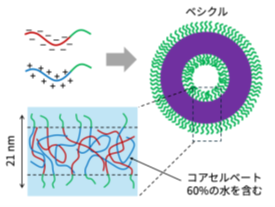
コアセルベートの膜から成るベシクル
<関連情報>
- https://www.sci.osaka-u.ac.jp/ja/topics/17420/
- https://journals.aps.org/prl/abstract/10.1103/vl6b-y5gz
液体が膜を形成するとき:コアセルベート小胞におけるエントロピー支配の曲げダイナミクス When Liquids Form Membranes: Entropy-Dominated Bending Dynamics in Coacervate Vesicles
Rintaro Takahashi, Tatsuro Oda, Koichi Mayumi, Shin-ichi Yusa, and Ken Terao
Physical Review Letters Published: 2 November, 2026
DOI:https://doi.org/10.1103/vl6b-y5gz
Abstract
Liquid interfaces and membranes represent two physically opposite regimes of interfacial dynamics: the former are governed by interfacial tension, while the latter are governed by bending elasticity. What happens when these two extremes are combined by confining a coacervate liquid within a membrane geometry is a largely unexplored question. Here, we probe the membrane dynamics of polyelectrolyte complex vesicles with coacervate cores using neutron spin echo spectroscopy. The relaxation rate follows Γ∼3 (where denotes the magnitude of the scattering vector), demonstrating that bending undulations prevail despite the intrinsically liquid nature of the constituents. However, the reduced relaxation rate 0Γ/B (where 0 and B denote the solvent viscosity and thermal energy, respectively) is more than an order of magnitude higher than that of lipid bilayers, despite the fourfold larger membrane thickness, indicating an exceptionally weak bending restoring force. This quantity remains invariant across temperatures and salt concentrations, indicating that the bending elasticity is entropic in origin. Thus, the geometric constraint of the vesicular structure imposes bending-undulation dynamics on an otherwise liquid interface while preserving the entropy-driven nature of the coacervate.