2026-11-08 すばる望遠鏡・国立天文台
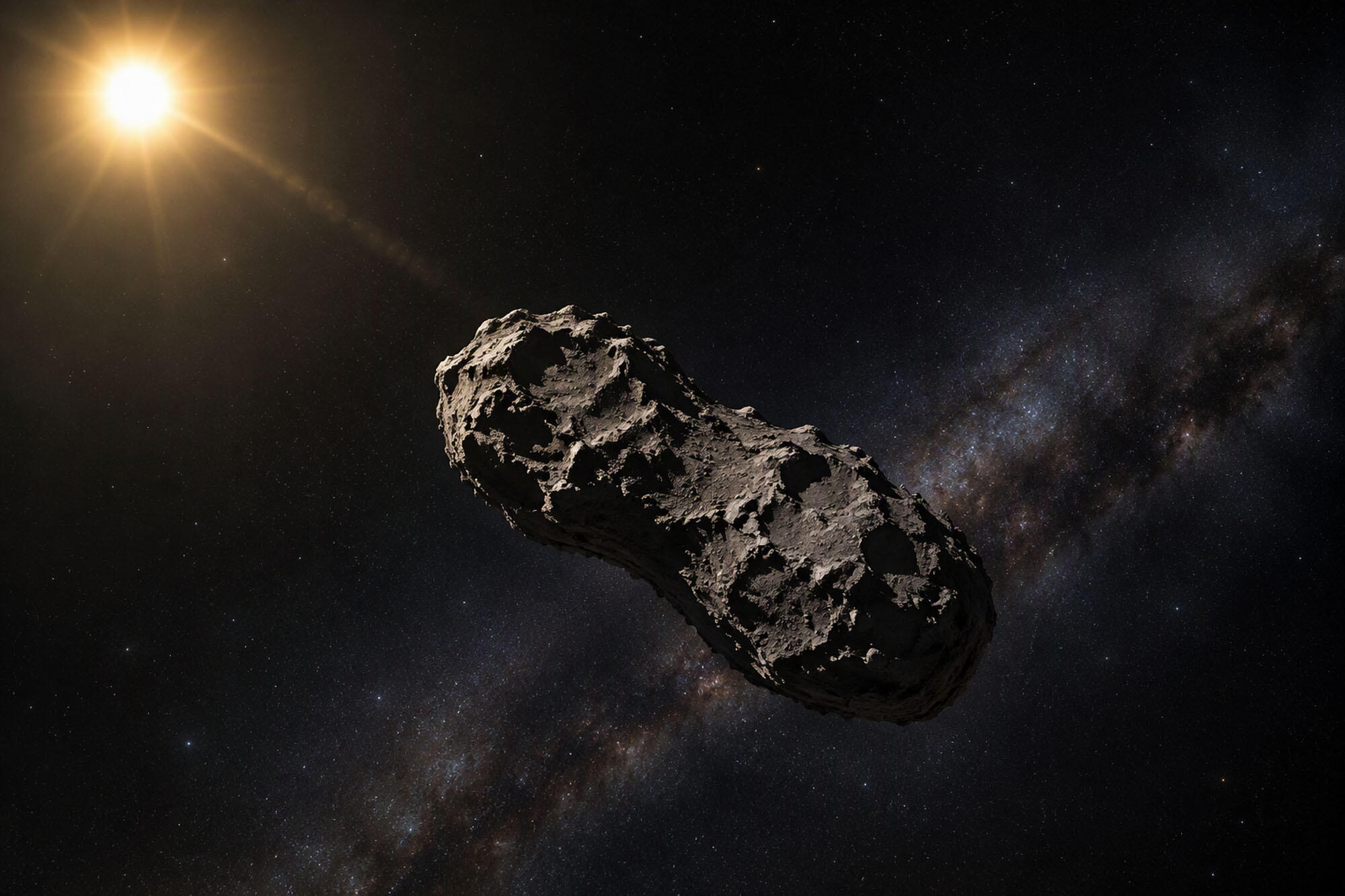
図1:エンケ彗星の彗星核の想像図(クレジット:京都産業大学(Microsoft Copilot使用))
<関連情報>
- https://subarutelescope.org/jp/results/2026/11/08/3772.html
- https://iopscience.iop.org/article/10.3847/1538-3881/aea614
彗星2P/エンケ核の中赤外線波長域における測光および分光観測 Photometric and Spectroscopic Observations of Comet 2P/Encke’s Nucleus in the Mid-infrared Wavelength Region
Takafumi Ootsubo, Hideyo Kawakita, Jun-ichi Watanabe, Hitomi Kobayashi, and Yoshiharu Shinnaka
The Astronomical Journal Published: 2026 November 9
DOI:10.3847/1538-3881/aea614
Abstract
We observed comet 2P/Encke with the Cooled Mid-Infrared Camera and Spectrometer on the Subaru telescope on UT 2003 November 12.3, when the comet was at heliocentric and geocentric distances of 1.09 and 0.27 au, respectively. Imaging observations of the comet with narrowband filters centered at 8.8, 10.5, 11.7, 12.4, 18.8, and 24.5 μm, and low-resolution spectroscopic observations in the N-band (8–13 μm, R ∼ 250) of the comet were performed. The observed spatial profiles of the comet were consistent with those of a standard star (FWHM ∼03 at 10.5 μm, close to the diffraction-limited image size), indicating that the observed spectrum was dominated by thermal emission from the cometary nucleus. The semiaxial ratio (a/b) of the nucleus of 2P/Encke is estimated as 2.26+0.33-0.21 based on the isothermal, prolate ellipsoid model. The photometric data with the correction for rotational phases, can be explained by a blackbody temperature of 328 ± 7 K, consistent with the nucleus surface temperature empirically estimated at 1.09 au from the Sun (327 K). This blackbody approximation for the nucleus leads to a=3.6+0.5-0.3km and b=1.6+0.2-0.2km by assuming an emissivity of unity. The observed low-resolution N-band spectrum showed an overall smooth continuum with no prominent excess emission feature at ∼10 μm due to fine silicate grains in the cometary coma. The relative emissivity spectrum of the nucleus showed a negative feature at ∼9.5 μm, as seen in the mid-infrared nucleus spectrum of 460P/PanSTARRS.