2026-04-08 合肥物質科学研究院(HFIPS)
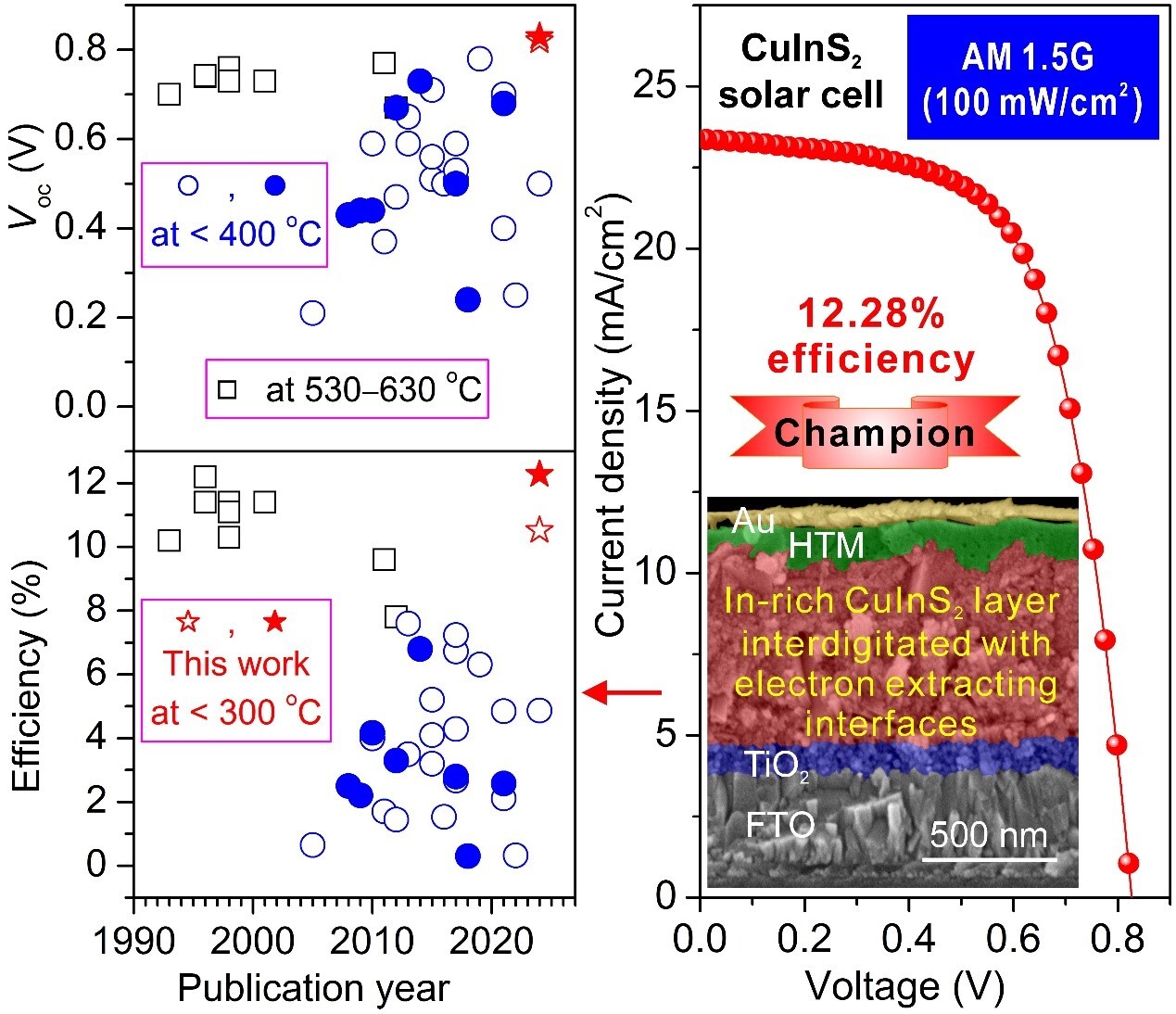
CuInS2 thin-film solar cell fabricated by low-temperature solution-processing strategy delivers new records of efficiency and open-circuit voltage. (Image by ZHANG Chaofan)
<関連情報>
- https://english.hf.cas.cn/nr/rn/202604/t20260408_1155377.html
- https://www.cell.com/joule/abstract/S2542-4351(26)00002-4
12%を超える効率を持つCuInS₂太陽電池を低温で製造する戦略 A low-temperature strategy to prepare CuInS2 solar cells with efficiency exceeding 12%
Wenbo Cao ∙ Chao Dong ∙ Dongxing Kou ∙ … ∙ Yingying Dong ∙ Chong Chen ∙ Mingtai Wang
Joule Published:March 6, 2026
DOI:https://doi.org/10.1016/j.joule.2026.102318
Context & scale
Photovoltaic (PV) conversion of solar energy into electricity is an up-and-coming renewable way to generate sustainable energy. Nowadays, PV development still remains constrained by the challenging demand for low-cost, stable, and efficient solar cells. The pursuit of such high-performance solar cells inspires the solution-processing approaches, which mainly involve a film matrix formation by facile technologies (e.g., spin-coating, doctor blading, screen printing, and inkjet printing) and a subsequent post-annealing at a low temperature (normally ≤ 500°C), to fabricate inorganic heterojunction films for stable and efficient solar cells. CuInS2 is a promising light-absorbing material because of its optimal band gap, large absorption coefficient, and eco-friendly elements. However, after the state-of-the-art efficiency of 12.2% was obtained at 600°C in 1996, the development of CuInS2 solar cells has been stagnating for nearly three decades.
In this work, a low-temperature (< 300°C) solution-processing strategy featuring the combination of an interdigitation structure and a sulfur anion-induced gradient phase transformation (S2−-GPT) is developed to fabricate efficient CuInS2 solar cells. Interdigitating electron-extracting interfaces into an In-rich CuInS2 absorber layer allows a much thicker CuInS2 layer with a high specific surface area of charge-separating interfaces to guarantee the high light absorption, charge generation, and charge extraction/spatial separation, while the S2−-GPT process improves the CuInS2 layer quality by reducing deep-level defects and enhancing charge collection efficiency for boosting total photovoltaic parameters. These findings demonstrate a low-temperature avenue with detailed principles for efficient CuInS2 solar cells that meet the essential requirements of the practical application on a large scale. In the long term, combining interdigitation structures and S2−-GPT processes in absorber layers offers a conceptual way to prepare solution-processed efficient chalcogenide solar cells.
Highlights
- The breakthrough efficiency of 12.28% is achieved in CuInS2 solar cells at < 300°C
- Absorber layer interdigitated by electron-extracting interfaces favors solar cells
- S2−-GPT takes place in an In-rich CuInS2 layer at a low temperature of 180°C
- Each phase transformation in the S2−-GPT process occurs locally in a short range
Summary
Copper indium sulfide (CuInS2) is a promising absorber among emerging chalcogenide photovoltaics. However, solution-processed CuInS2 solar cells at low temperature (< 400°C) still lag far behind the requirement of at least 10% efficiency for practical application since 1993. Here, a low-temperature strategy, featuring a solution-processed In-rich CuInS2 film interdigitated with electron-extracting interfaces and a sulfur anion-induced gradient phase transformation (S2−-GPT) process at < 200°C, is conceptually developed for preparing the CuInS2 solar cells with a breakthrough efficiency up to 12.28%. The interdigitated structure has unique advantages over the simple bilayer structure conventionally used; moreover, the S2−-GPT process leads to the transformation from CuAu to CuIn5S8 phase to reduce the defect density and charge recombination inside CuInS2 film for boosting solar cell performance. The detailed principles behind material and device are elucidated. Our findings offer a promising way to chalcogenide solar cells and the application of CuInS2 devices.