2026-03-30 中国科学院(CAS)
<関連情報>
- https://english.cas.cn/newsroom/research-news/202603/t20260326_1153795.shtml
- https://www.nature.com/articles/s41558-026-02606-z
建物の外壁に設置された太陽光発電システムは、地球規模の気候変動への耐性を高める Building façade photovoltaics enhance global climate resilience
Hou Jiang (姜侯),Ling Yao (姚凌),Jun Qin (秦军),Wenli Zhao (赵文利),Tang Liu (刘唐),Rui Zhu (朱瑞),Fangyu Ding (丁方宇),Jia Wang (王佳),Xingxing Zhang (张星星),Fan Zhang (张帆),Ning Lu (吕宁),Fenzhen Su (苏奋振) & Chenghu Zhou (周成虎)
Nature Climate Change Published:27 March 2026
DOI:https://doi.org/10.1038/s41558-026-02606-z
Abstract
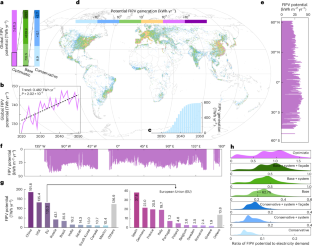
Climate change is intensifying global energy demands and amplifying exposure to extreme heat. Building façade-integrated photovoltaics (FIPV) present a largely untapped opportunity to supply renewable electricity while enhancing urban climate resilience. Here we show that deployable FIPV systems worldwide could generate 732.5 ± 4.5 TWh of electricity annually, based on a global synthesis of building datasets, climate projections and façade-scale simulations, with theoretical bounds of 8.9–7,671.3 TWh under conservative-to-optimistic assumptions. Although FIPV deployment costs exceed those of conventional photovoltaics, over 80% of urban districts exhibit lifetime expenditure savings due to combined electricity generation and cooling-load reductions. Under a gradual S-curve adoption reaching upper-bound potential by 2050, FIPV could deliver cumulative emission reductions of up to 37.7 GtCO2, corresponding to 0.0519 ± 0.0111 °C of avoided warming under currently announced national policies. These results identify FIPV as a complementary mitigation–adaptation strategy, highlighting the need for targeted policies to address regional and economic disparities in climate-resilient urban transition.