
2026-03-24 デルフト工科大学(TU Delft)
<関連情報>
- https://www.tudelft.nl/en/stories/articles/melting-ice-rising-ground-a-new-perspective-on-sea-level-predictions
- https://www.nature.com/articles/s41467-025-66435-y
岩盤の隆起により、今後数世紀にわたって南極の海面上昇への寄与が減少する Bedrock uplift reduces Antarctic sea-level contribution over next centuries
C. J. van Calcar,J. Bernales,C. J. Berends,W. van der Wal & R. S. W. van de Wal
Nature Communications Published:27 November 2025
DOI:https://doi.org/10.1038/s41467-025-66435-y
Abstract
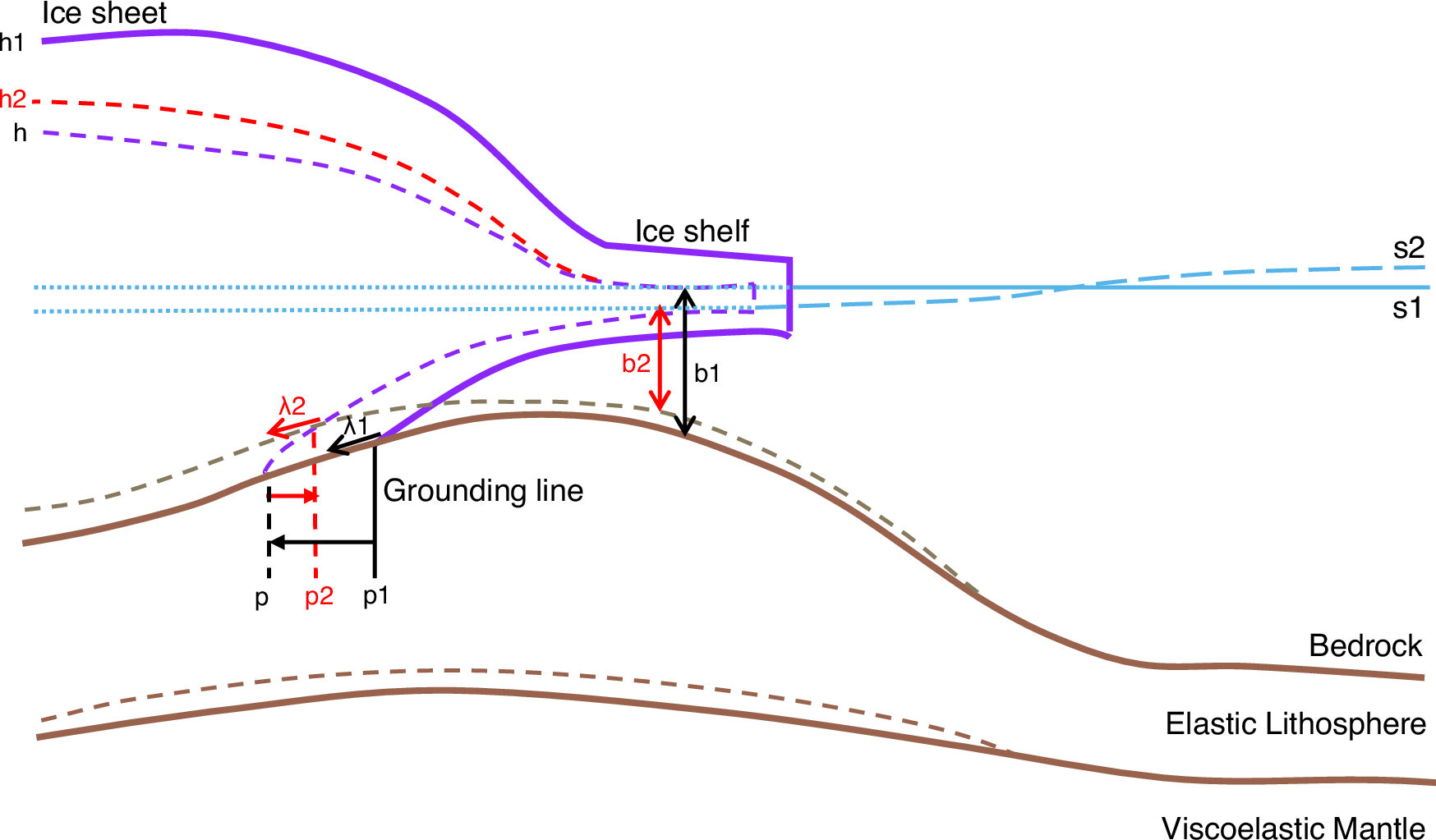
The contribution of the Antarctic Ice Sheet to barystatic sea-level rise could be as high as eight metres around 2300 but remains deeply uncertain. Ice sheet retreat causes bedrock uplift, which can exert a stabilising effect on the grounding line. Yet, sea-level projections exclude bedrock adjustment, use simplified Earth structures or omit the uncertainty in climate response and Earth structure. We show that the grounding line retreat is delayed by 50 to 130 years and the barystatic sea-level contribution reduced by 9–23% when the heterogeneity of the solid Earth is included in a coupled ice – bedrock model under different emission scenarios till 2500. The effect of the solid Earth feedback in ice sheet projections can be twice as large as the uncertainty due to differences between climate models. We emphasise that realistic Earth structures should be considered when projecting the Antarctic contribution to barystatic sea-level rise on centennial time scales.

