2026-03-25 ロイヤルメルボルン工科大学(RMIT)
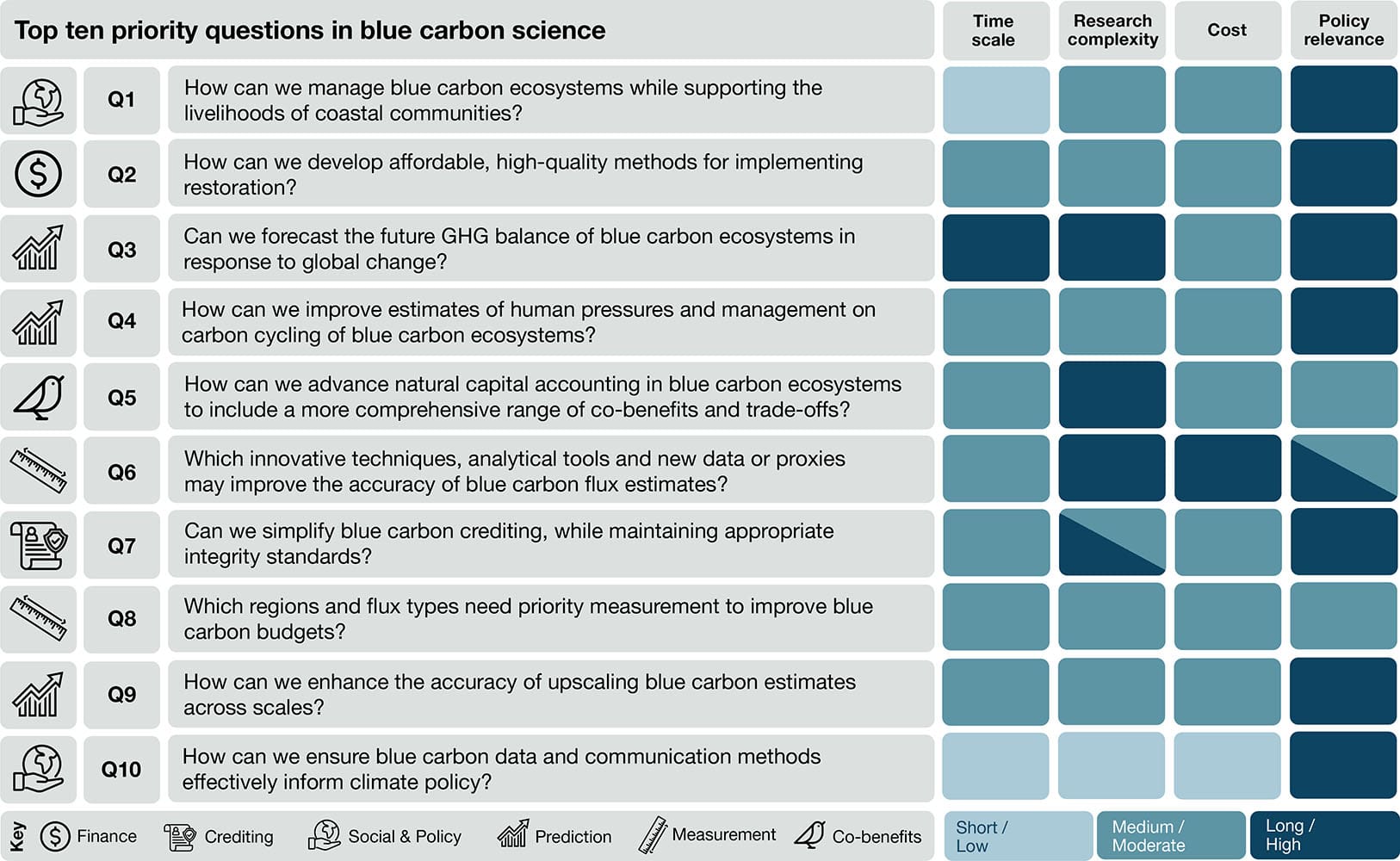
Top ten research priority questions for scalable, high-integrity management of blue carbon ecosystems.
<関連情報>
- https://www.rmit.edu.au/news/all-news/2026/mar/global-study-identifies-urgent-blue-carbon-priorities-in-the-fight-against-climate-change
- https://www.nature.com/articles/s41559-026-03020-6
今後10年間のブルーカーボン科学における優先課題 Priority questions for the next decade of blue carbon science
Peter I. Macreadie,George E. Biddulph,Pere Masque,Hilary Kennedy,Jimena Samper-Villarreal,J. Patrick Megonigal,Hannah K. Morrissette,Tania E. Romero-Gonzalez,Vanessa Hatje,Jana Friedrich,Sigit D. Sasmito,Kenta Watanabe,Inés Mazarrasa,Dorte Krause-Jensen,Janine B. Adams,Miguel Cifuentes-Jara,Ariane Arias-Ortiz,Andre S. Rovai,Milica Stankovic,Kirsten Isensee,Ana M. Queirós,Luzhen Chen,Jorge Herrera-Silveira,Catriona L. Hurd,… William E. N. Austin
Nature Ecology & Evolution Published:24 March 2026
DOI:https://doi.org/10.1038/s41559-026-03020-6
Abstract
Blue carbon ecosystems, classically defined as mangroves, tidal marshes and seagrasses, but increasingly expanded to include ecosystems such as tidal flats, macroalgal forests and shelf sediments, contribute to climate change mitigation and biodiversity support. Here, seven years after the last global assessment of research priorities, we conducted a priority-setting exercise to identify persistent knowledge and implementation gaps, and the strategic priorities that must be addressed to enable scalable, high-integrity and equitable management of blue carbon ecosystems in a rapidly evolving policy and finance landscape. The highest priority focuses on managing blue carbon ecosystems to support coastal communities while integrating traditional ecological knowledge, emphasizing the essential role of social legitimacy and equity in enabling scalable, long-lasting outcomes. Additional priorities focus on developing cost-effective restoration methods, improving the accuracy of greenhouse gas flux estimates, quantifying the impacts of human activities on carbon cycling and integrating co-benefits such as biodiversity and coastal protection into natural capital frameworks. Emerging technologies like remote sensing, machine learning and data-sharing platforms are also highlighted as transformative tools to fill knowledge gaps and scale solutions. Collectively, these priorities highlight the complexity of blue carbon science and the need for inclusive interdisciplinary approaches that support the resilience and livelihoods of coastal communities.