2026-03-18 ロックフェラー大学
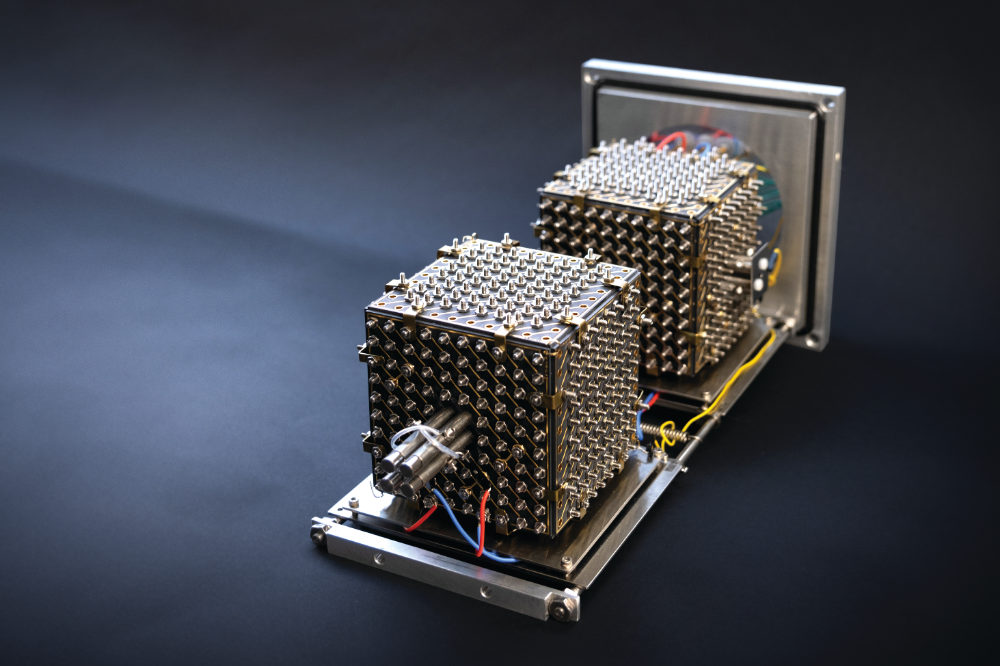
The new MultiQ-IT prototype can cool, trap, filter, and redirect over a billion ions simultaneously, dramatically improving dynamic range and signal-to-noise. (Credit: Lori Chertoff)
<関連情報>
- https://www.rockefeller.edu/news/39200-most-mass-spectrometers-can-process-just-a-few-molecules-at-once-a-reengineered-prototype-does-a-billion-simultaneously/
- https://www.science.org/doi/10.1126/sciadv.aec7048
自然界に着想を得たイオントラップによる、大規模なイオンの並列操作 A nature-inspired ion trap for parallel manipulation of ions on a massive scale
Andrew N. Krutchinsky and Brian T. Chait
Science Advances Published:18 Mar 2026
DOI:https://doi.org/10.1126/sciadv.aec7048
Abstract
Parallelization has revolutionized computing and DNA sequencing but remains largely unexploited in mass spectrometry (MS), which typically analyzes ions sequentially. Inspired by nuclear cytoplasmic transport, where diffusion governs transport to multiple gated channels (nuclear pore complexes), we introduce an ion trap (MultiQ-IT) that enables massively parallel MS. The device comprises a cubic array of small quadrupoles forming multiple ion entry and exit ports, allowing >109 ions to be cooled, confined, and manipulated simultaneously. This architecture enables selective depletion of singly charged ions, thereby enhancing signal-to-noise ratios and expanding the effective dynamic range. The trap also functions as a parallel ion splitter, transmitting ions into multiple mass/charge ratio–specific beams. We demonstrate scalable ion throughput, real-time charge discrimination, and parallel beam separation, suggesting a path toward truly parallel MS. Our results establish a conceptual framework for next-generation, high-throughput proteomic and metabolomic analyses.