2026-03-03 イリノイ大学アーバナ・シャンペーン校
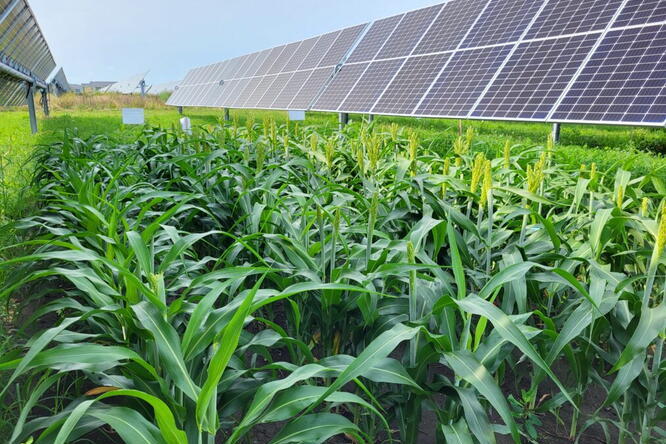
A new study examines the agricultural and economic trade-offs that come with installing solar arrays on working farms across the Midwest. Photo courtesy the U. of I. Institute for Sustainability, Energy, and Environment.
<関連情報>
- https://aces.illinois.edu/news/illinois-team-tests-costs-benefits-agrivoltaics-across-midwest
- https://agupubs.onlinelibrary.wiley.com/doi/10.1029/2025MS005092
コミュニティ・ランド・モデル・バージョン5を用いたアグリボルタイクスによる水、エネルギー、炭素循環への影響の評価 Assessing the Impact of Agrivoltaics on Water, Energy, and Carbon Cycles Using the Community Land Model Version 5
Mengqi Jia, Bin Peng, Kaiyu Guan, David M. Lawrence, Evan H. DeLucia, Danica L. Lombardozzi, Matthew A. Sturchio, Steven A. Kannenberg, Alan K. Knapp, Xuzhi Du, Alson Time …
Journal of Advances in Modeling Earth Systems Published: 29 January 2026
DOI:https://doi.org/10.1029/2025MS005092
Abstract
Agrivoltaics, combining agriculture with photovoltaic systems, offers a promising solution to address land-use conflict between food and energy production. However, the complexities of agrivoltaics and its effects on the water-energy-carbon interactions remain poorly understood. In this study, we developed a process-based agrivoltaic model within the Community Land model 5 to assess the impacts of agrivoltaics on water, energy, and carbon cycles. The model was validated using data from agrivoltaic sites in Illinois and Colorado, generally capturing spatiotemporal variations in light conditions, soil moisture, and biomass carbon. Simulation results suggest that agrivoltaics significantly impact water, energy, and carbon budgets at the patch and system levels for maize and soybean in Illinois and grass in Colorado (2000–2014). Our findings show that the impacts of agrivoltaics vary by climate conditions and plant types. In dry climates, rainfall redistribution and shading from agrivoltaics conserve soil moisture and enhance evapotranspiration, promoting greater carbon assimilation and soil carbon storage for C3 grass. Conversely, in wetter regions, reduced solar radiation from shading becomes the dominant factor, lowering carbon assimilation and sequestration for maize and soybean. These results suggest that agrivoltaics can help mitigate drought impacts in arid environments. Our analysis of land equivalent ratios across different photovoltaic ground coverage ratios (PV GCR) shows that a medium PV GCR (60%) under “AgPV” deployment, where PV and plants share the same land, maximizes land-use efficiency at the study sites. Our modeling study supports informed decision-making to promote sustainable management of water, energy, and food resources amid environmental change.