

2026-02-25 ハーバード大学
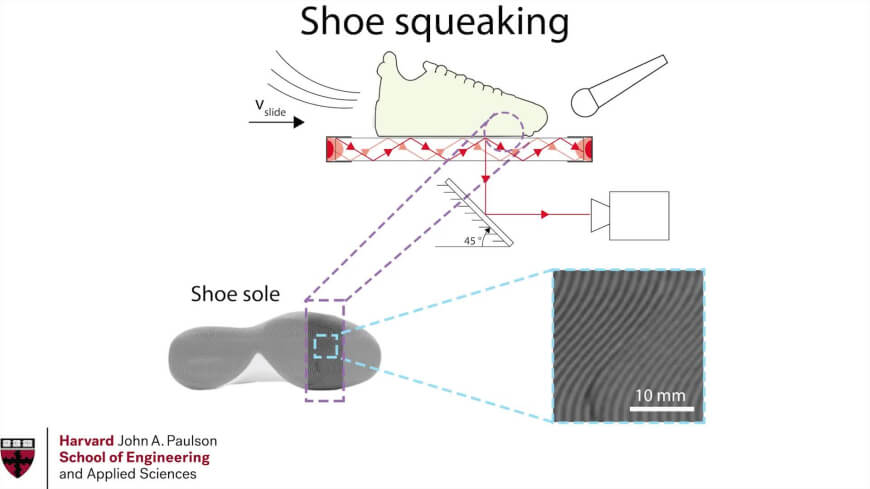
Visualization of the frictional interface when sliding a basketball shoe.
<関連情報>
軟質‐硬質摩擦界面におけるきしみ音 Squeaking at soft–rigid frictional interfaces
Adel Djellouli,Gabriele Albertini,Jackson Wilt,Vincent Tournat,David Weitz,Shmuel Rubinstein & Katia Bertoldi
Nature Published:25 February 2026
DOI:https://doi.org/10.1038/s41586-026-10132-3
Abstract
Squeaking is a constant companion in various aspects of our daily lives, whether we slide rubber-soled shoes across hardwood floors1, scrape chalk on a blackboard2, engage the brakes on a bicycle3 or walk with a hip replacement4,5. When two rigid bodies slide over each other, squeaking is widely understood to result from self-excited stick–slip oscillations, triggered by a decrease in the friction coefficient with increasing slip velocity6,7,8,9,10. However, sliding of extended interfaces can involve crack or slip-pulse propagation11,12,13,14,15,16,17,18,19,20,21. This distinction is amplified when a soft body slides on a rigid one, in which large deformations and material mismatch can cause detachment by opening slip pulses22,23,24,25,26,27. Previous studies focused mainly on slow sliding17,26,28,29,30,31,32,33,34, in which pulses are slow and squeaking is absent. Although squeaking at soft–rigid interfaces has been linked to stick–slip oscillations35,36,37, the mechanisms remain unclear. Here we experimentally investigate soft–rigid interfaces sliding at velocities that produce squeaking. High-speed imaging and acoustic analysis show that opening pulses propagate at approximately the shear wave speed of the soft material, mediating local slip across diverse materials. In flat samples, these pulses are irregular and generate broadband acoustic emissions. Introducing thin surface ridges confines pulse propagation, yielding a consistent repetition frequency matching the first shear mode of the sliding block and squeaking at that frequency. These findings show a structure-driven mechanism that stabilizes rupture in bimaterial friction. Geometric confinement suppresses competing modes, transforming irregular two-dimensional dynamics into coherent one-dimensional pulse trains, offering new insights into frictional rupture from engineered surfaces to geological faults.

