2026-02-23 スイス連邦工科大学ローザンヌ校(EPFL)
<関連情報>
- https://actu.epfl.ch/news/dogs-affect-the-quality-of-our-indoor-air/
- https://pubs.acs.org/doi/10.1021/acs.est.5c13324
私たちの親友:犬が室内の空気質を変える仕組み Our Best Friends: How Dogs Alter Indoor Air Quality
Shen Yang,Nijing Wang,Tatjana Arnoldi-Meadows,Gabriel Bekö,Meixia Zhang,Marouane Merizak,Pawel Wargocki,Jonathan Williams,Martin Täubel,and Dusan Licina
Environmental Science & technology Published: February 1, 2026
DOI:https://doi.org/10.1021/acs.est.5c13324
Abstract
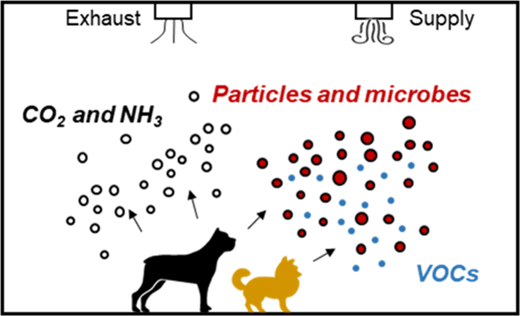
Dogs are dynamic contributors to the indoor environment, yet their impact on air quality remains largely unexplored, warranting a comprehensive assessment of their pollutant emissions. This study characterized chemical, particulate, and microbial emissions from small and big dogs. Big dogs emitted CO2, NH3, fungi, and bacteria at considerably higher rates than small dogs, whereas their emissions of 1–10 μm particles were similar. With ozone present, all dogs contributed to the formation of nanocluster aerosols (1–3 nm) and ozonized volatile organic compound (VOC) products, likely from human skin oil transfer through petting. With ozone present, nanocluster aerosols (1–3 nm) were observed during dog experiments, likely reflecting ozone reactions with human-derived skin lipids transferred onto dog fur. Relative to a seated adult, big dogs emitted less ozonized products, comparable CO2 and NH3, more >5 μm coarse particles (fewer 2–5 μm particles), 2–4× more bacteria and fungi, and showed compound-specific differences in VOCs: while some species exhibited a strongly elevated dog-to-human ratio (with one up to 15×), others were not pronounced when dogs were present. Our findings highlight dogs as significant indoor emission sources and contributors to indoor air chemistry and microbial transport, with implications for air quality and exposure assessment.