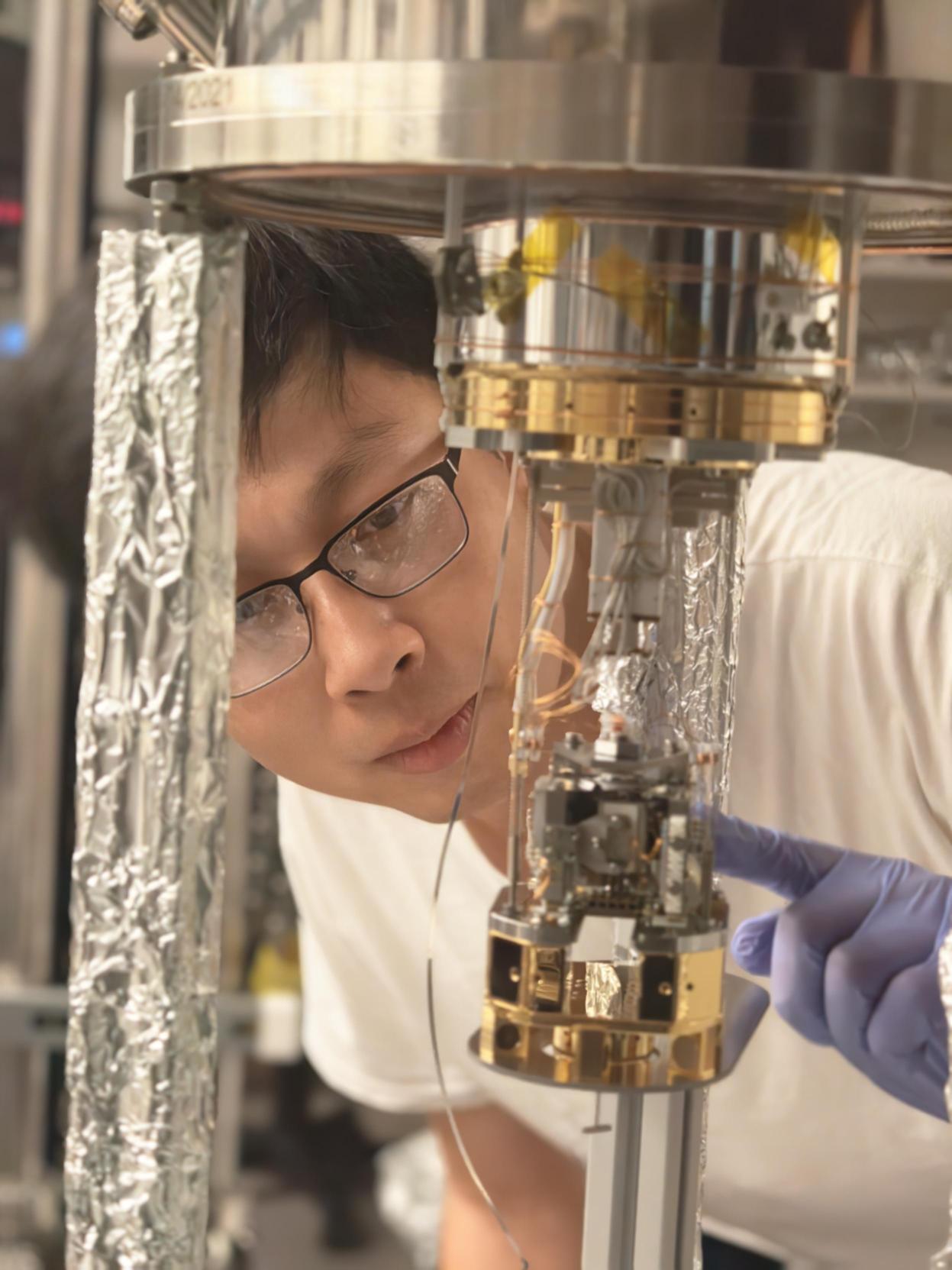
2026-02-17 コロンビア大学
<関連情報>
- https://zuckermaninstitute.columbia.edu/making-world-s-best-microscopes-biology-better
- https://elifesciences.org/reviewed-preprints/109793v1
電子顕微鏡における位相変調のためのパルスレーザーレンズ Pulsed laser lensing for phase modulation in electron microscopy
Daniel X Du,Adam C Bartnik,Cameron JR Duncan,Usama Choudhry,Tanya Tabachnik,Chaim Sallah,Yuki Ogawa,Ebrahim Najafi,Ding-Shyue Yang,Anthony WP Fitzpatrick,…
eLife Reviewed Preprint v1:February 17, 2026
DOI:https://doi.org/10.7554/eLife.109793.1

Abstract
Phase contrast electron microscopy is fundamental for visualizing unstained biological specimens. Advances in electron detection have not yet overcome the low contrast caused by weak scattering. Here, we demonstrate that an orthogonal pulsed laser-electron beam interaction produces a pronounced peak phase shift of 430 radians through ponderomotive defocusing, leading to a maximum angular deflection of 45 µrad. Experiments encompassing a variety of probe pulse energies and pump positions verified the properties of the electron pulses in a range of pulse durations from 5.8 ± 1.9 ps to 13.4 ± 0.9 ps and a width of 15.0 ± 2.6 µm at the interaction region. The stability of the beam was also tested across 10 hours of cumulative acquisition time, with only small variations in laboratory conditions resulting in a gradually shifting baseline measurement. Pulsed laser lensing of the electron beam offers the potential for refinement in phase shift and electron beam shaping with careful consideration to the overlap between laser and electron pulses. Calculations of phase shifts across a wide experimental envelope show that poorly chosen laser parameters can generate large incoherent distributions at both 30 keV and 300 keV. Thus, a delicate balance between laser and electron widths and pulse durations must be struck to adequately achieve uniform phase shifts, particularly when singling out specific beamlets in the back-focal-plane.