2026-02-18 ペンシルベニア州立大学(Penn State)
<関連情報>
- https://www.psu.edu/news/research/story/plant-based-material-offers-sustainable-method-recovering-rare-earth-element
- https://advanced.onlinelibrary.wiley.com/doi/10.1002/adfm.202526281
- https://www.sciencedirect.com/science/article/abs/pii/S1385894721026681
ナノセルロースの化学構造制御による希土類元素ジスプロシウムとネオジムの選択的分離 Selective Separation of the Rare Earth Elements Dysprosium and Neodymium via Tailoring Nanocellulose Chemical Structure
Roya Koshani, Shang-Lin Yeh, Karuna Anna Sajeevan, Mica L. Pitcher, Dawson Alexander, Ratul Chowdhury, Amir Sheikhi
Advanced Functional Materials Published: 16 February 2026
DOI:https://doi.org/10.1002/adfm.202526281
ABSTRACT
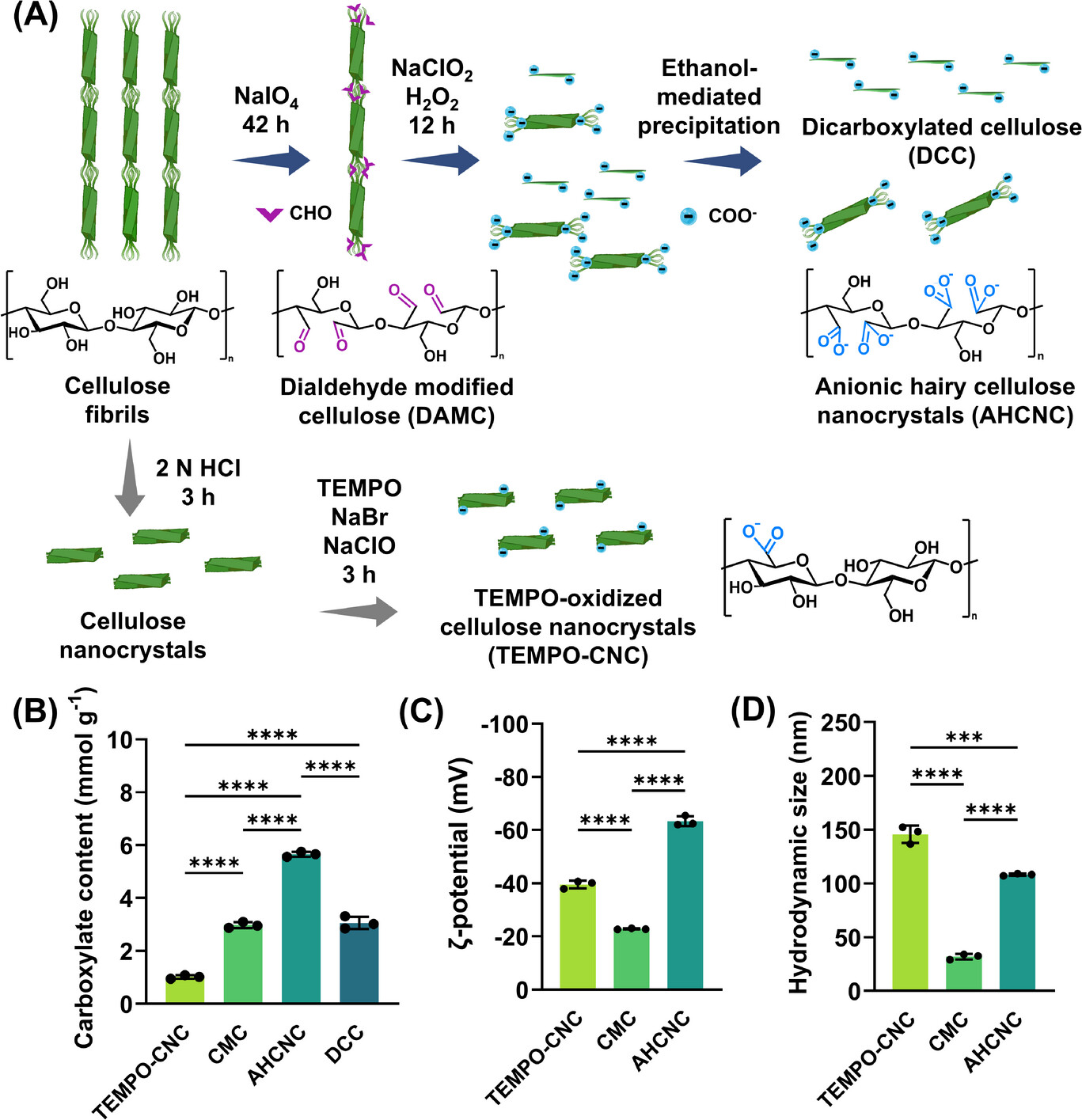
Dysprosium(III) (DyIII) is one of the widely used heavy rare earth elements (HREE) for developing advanced magnetic devices and clean energy technologies because of temperature stability and coercivity. DyIII separation from light rare earth elements (LREE), such as neodymium(III) (NdIII), is however extremely difficult as a result of subtle differences in ionic radius and coordination number. Here, we report preferential DyIII adsorption by dicarboxylate-modified disordered cellulose chains (hairs) in anionic hairy cellulose nanocrystals (AHCNC) and show that monocarboxylate-modified celluloses do not have such selectivity. The AHCNC selectivity (ion distribution factor) of DyIII is ∼ 16.65 times that of NdIII, supported by the binding affinity for DyIII which is ∼ 6.8 times that for NdIII, measured using isothermal titration calorimetry. Molecular dynamics simulation provides insights into the molecular basis for the preferential DyIII binding to AHCNC over other monocarboxylate-modified cellulose derivatives, highlighting a collective contribution from inter- and intra-molecular hydrogen bonding, ionic interactions between dicarboxylate groups and metal ions, and the compressive strain-induced shrinkage of dicarboxylate “hairs”. The computational interaction energy scores and normalized probability of ion distribution trends corroborate with the experimental adsorption selectivity. This study shows how a facile chemical modification of cellulose renders it a selective biopolymer for DyIII recovery. The experimental and theoretical findings of this work may lay the foundation for developing highly selective bio-derived sorbents, enabling sustainable, selective HREE recovery from complex ion mixtures.
ネオジムを選択的に除去するためのセルロースナノ工学:持続可能な希土類元素回収に向けて Nanoengineering cellulose for the selective removal of neodymium: Towards sustainable rare earth element recovery
Patricia Wamea, Mica L. Pitcher, Joy Muthami, Amir Sheikhi
Chemical Engineering Journal Available online: 3 July 2021
DOI:https://doi.org/10.1016/j.cej.2021.131086
Highlights
- An advanced sustainable material for neodymium ion (Nd3+) removal was proposed.
- Nanoengineering cellulose fibrils yielded anionic hairy nanocelluloses (AHNC).
- AHNC enabled high capacity (264 ± 14 mg/g), selective removal of Nd3+.
- Colloidal nature of AHNC enables rapid (within seconds) Nd3+ removal.
- The AHNC technology is a step forward in sustainable rare earth element recovery.
Abstract
Rare earth elements (REE) have exceedingly become critical in advanced industries. Despite the high demand for REE, the world is still experiencing a shortage in ready-to-exploit resources, environmentally friendly processing, and reliable recovery strategies, rendering sustainable REE removal an immediate and unmet environmental, industrial, and economical challenge worldwide. We nanoengineered cellulose, the most abundant biopolymer in the world, to develop a sustainable bio-based technology named anionic hairy nanocellulose (AHNC) for the high-capacity and selective removal of neodymium ions (Nd3+), one of the most widely used REE, from aqueous media. AHNC comprises fully solubilized dicarboxylated cellulose (DCC) chains and cellulose nanocrystals (CNC) decorated with DCC (hairs) bearing a charge density that is about one order of magnitude higher than conventional CNC. The unique colloidal properties of AHNC, particularly the polyanionic hairs, enable the removal of ~ 264 ± 14 mg of Nd3+ per gram of the nanoadsorbent within seconds, which, to the best of our knowledge, place this advanced material among the adsorbents with the highest removal capacity at the shortest contact time. We investigated the roles of ionic strength, pH, and competing iron species on the performance of AHNC. Besides Nd3+ removal at high initial Nd3+ concentrations (C0 > 150 ppm) wherein AHNC is fully neutralized and precipitated, we show, for the first time, that at C0 ≤ 100 ppm wherein AHNC maintains its partial colloidal stability, Nd3+ removal can be enhanced via complementary calcium ion-mediated colloidal bridging. Together, our colloidal engineering approach combined with the biorenewability of cellulose and an ambient, low-cost unit operation, renders AHNC a promising sustainable nanotechnology for the removal of Nd3+ from industrial wastewater, mining tails, e-waste, and NdFeB permanent magnet leachates.