2026-02-18 東北大学
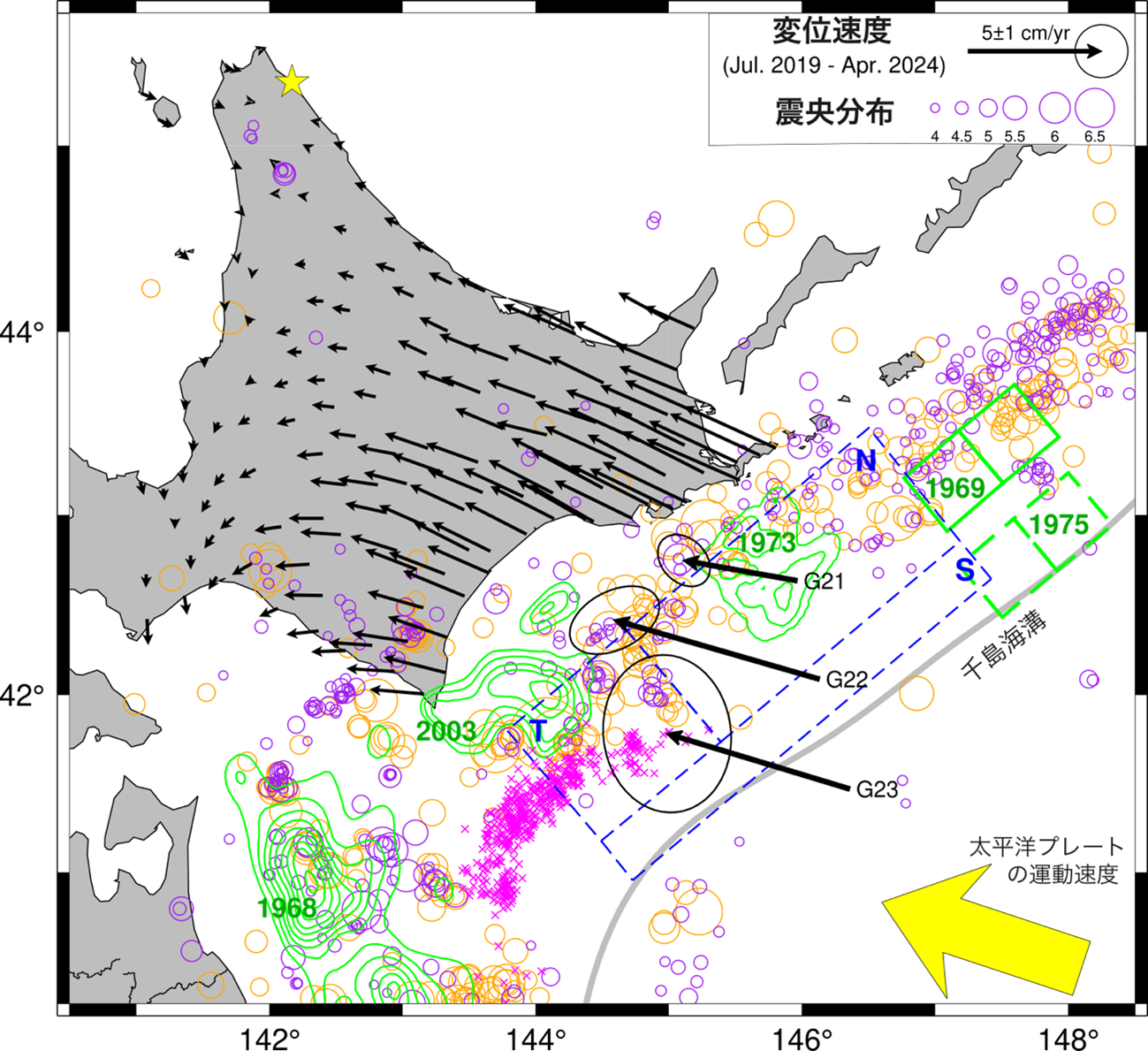
図1.北海道沖での過去の地震活動、および現在の地表面変位速度
<関連情報>
- https://www.tohoku.ac.jp/japanese/2026/02/press20260218-01-seafloor.html
- https://www.tohoku.ac.jp/japanese/newimg/pressimg/tohokuuniv-press20260218_01web_seafloor.pdf
- https://www.nature.com/articles/s43247-026-03297-2
千島海溝南西部付近の海底地殻変動の証拠 Seafloor geodetic evidence of slip deficit near the southwestern Kuril Trench
Fumiaki Tomita,Yusaku Ohta,Motoyuki Kido,Mako Ohzono,Hiroaki Takahashi,Ryota Hino & Takeshi Iinuma
Nature Earth & Environment Published:14 February 2026
DOI:https://doi.org/10.1038/s43247-026-03297-2 An unedited version of this manuscript
Abstract
Understanding near-trench interseismic deformation at subduction zones is crucial for assessing the hazards of giant earthquakes, especially trench-breaking tsunamigenic earthquakes, such as the 2011 Tohoku earthquake. However, interseismic locking preceding such trench-breaking tsunamigenic events remain poorly constrained due to the limited sensitivity of onshore geodetic observations. Here, we present seafloor geodetic observations along the southwestern Kuril trench, a region with the potential for large coseismic ruptures reaching the trench, as inferred from historical tsunami records. Our results show high slip-deficit rates near the trench during 2019–2024 and suggest that a slip deficit of 20.5–30.0 m may have accumulated over the past ~400 years, considering the long-term low seismic activity in this region. These findings imply future recurrence of a megathrust earthquake (Mw ~8.8) with rupture reaching the Kuril trench. Furthermore, they highlight the importance of seafloor geodetic monitoring for seismic and tsunami hazard assessment at subduction zones.