2026-02-17 マサチューセッツ大学アマースト校
<関連情報>
- https://www.umass.edu/news/article/international-team-astronomers-led-umass-amherst-may-have-just-found-one-missing-links
- https://iopscience.iop.org/article/10.3847/2041-8213/ae382a
ALMAとJWSTによるz∼8までの微弱な塵星形成銀河の同定 と他の銀河種族との関連性 ALMA and JWST Identification of Faint Dusty Star-forming Galaxies up to z ∼ 8 and Their Connection with Other Galaxy Populations
Jorge A. Zavala, Andreas L. Faisst, Manuel Aravena, Caitlin M. Casey, Jeyhan S. Kartaltepe, Felix Martinez III, John D. Silverman, Sune Toft, Ezequiel Treister, Hollis B. Akins,…
Astrophysical Journal Letters Published: 2026 February 11
DOI:10.3847/2041-8213/ae382a
Abstract
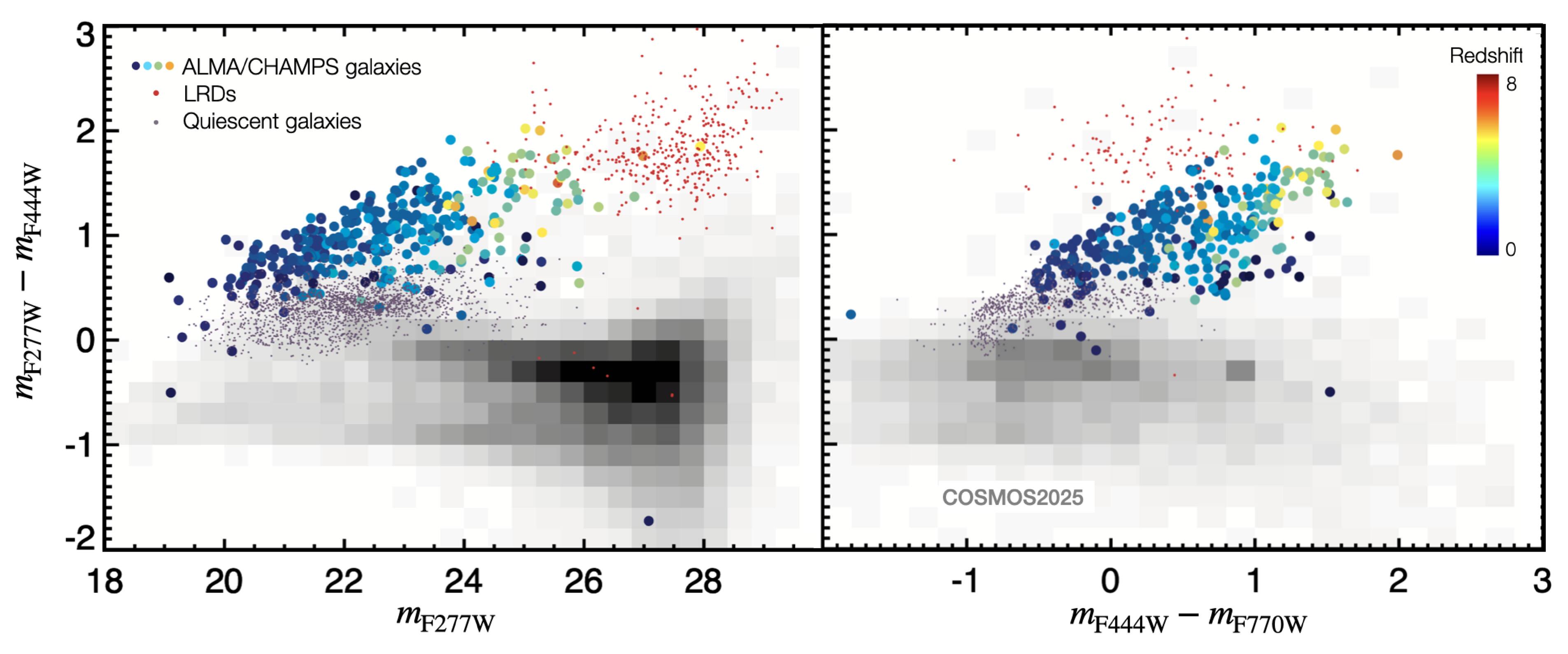
We exploit a new sample of around 400 bright dusty galaxies from the Atacama Large Millimeter/submillimeter Array (ALMA) CHAMPS Large Program, together with the rich JWST multiband data products in the COSMOS field, to explore and validate new selection methods for identifying dusty star-forming galaxies (DSFGs). Here we present an effective empirical selection criterion based on a newly defined parameter:I*≡log10(M*)×log10(SFR) . Incorporating the m277W − m444W color as a second parameter further improves the purity of the selection. We then apply this method to the COSMOS2025 catalog to search for fainter dusty galaxy candidates below the ALMA CHAMPS detection limit and, through a stacking technique, identify a population of high-redshift DSFG candidates with an average flux density of S1.2mm ≈ 150 μJy and a space density of ∼6 × 10⁻⁶ Mpc−3. Three of these galaxies have been spectroscopically confirmed at zspec = 7.20, 5.85, and 5.04. This faint population seems to have been missed by most of the previous submillimeter/millimeter surveys and ground- and space-based UV−near-IR observations. We then show evidence of a possible evolutionary connection between the z > 10 UV-bright galaxies recently discovered by JWST, the faint dusty z ≈ 6-8 galaxies identified here, and the population of z ≈ 3–5 massive quiescent galaxies; all of them are potentially linked as progenitor−descendant populations based on their abundance, redshifts, and stellar masses. Future spectroscopic campaigns will be essential to confirm the redshifts and physical properties of these massive, faint, high-redshift DSFG candidates.