2026-02-17 東北大学
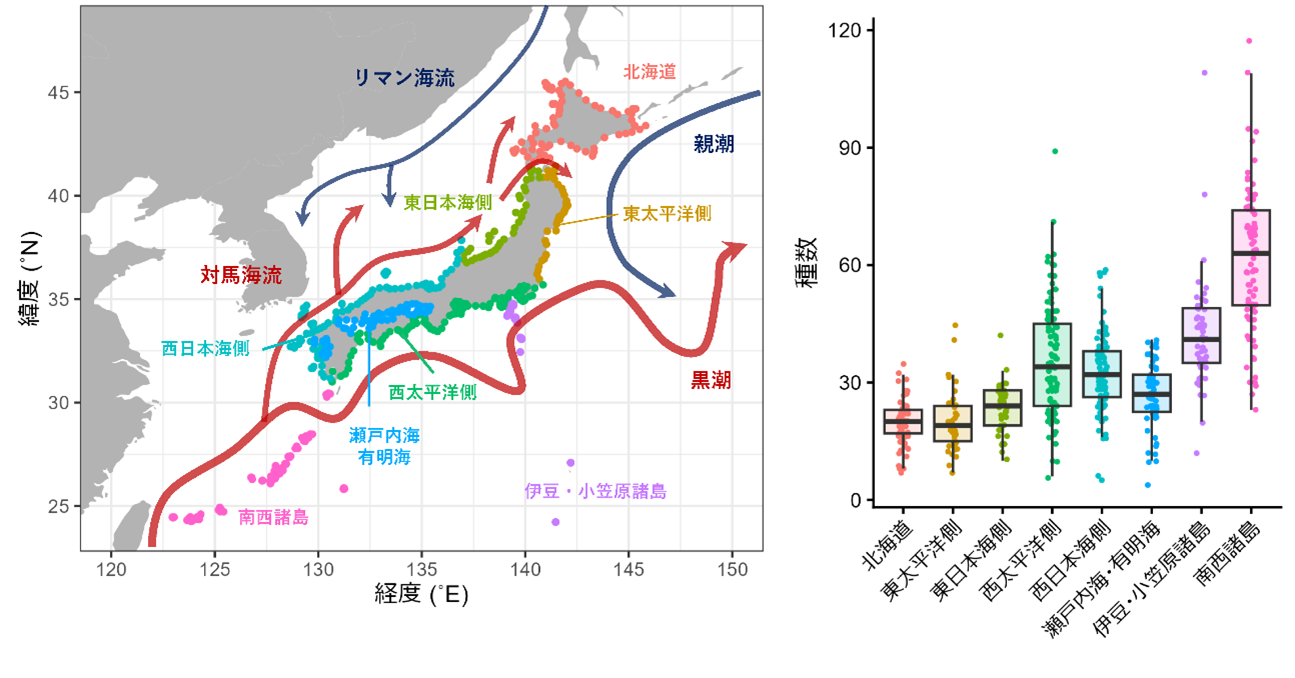
図1. 調査が行われた地点(左図)と各調査地で検出された種数(右図)。多い地点では一度の調査で118種もの魚種を検出しました。右図は箱ひげ図と呼ばれています。箱が四分位点を、中央の太線が中央値を表します。太線の位置によって各地域の種数を直感的に比較することができます。また、箱の大きさによって各地域内で種数がどのくらいばらついているかを調べることができます。
<関連情報>
- https://www.tohoku.ac.jp/japanese/2026/02/press20260217-02-DNA.html
- https://www.tohoku.ac.jp/japanese/newimg/pressimg/tohokuuniv-press20260217_02web_DNA.pdf
- https://www.nature.com/articles/s41598-025-31307-4
大規模な環境DNA調査により、地域沿岸魚類群集のニッチ軸が明らかに Large-scale environmental DNA survey reveals niche axes of a regional coastal fish community
Yutaka Osada,Masaki Miya,Hitoshi Araki,Hideyuki Doi,Akihide Kasai,Reiji Masuda,Toshifumi Minamoto,Satoquo Seino,Teruhiko Takahara,Satoshi Yamamoto,Hiroki Yamanaka,Mitsuhiro Aizu-Hirano,Keiichi Fukaya,Takehiko Fukuchi,Ryo O. Gotoh,Masakazu Hori,Midori Iida,Tomohito Imaizumi,Tadashi Kajita,Takashi Kanbe,Tanaka Kenta,Yumi Kobayashi,Tomohiko Matsuura,Hiroki Mizumoto,… Michio Kondoh
Scientific Reports Published:16 February 2026
DOI:https://doi.org/10.1038/s41598-025-31307-4
Abstract
The concept of the ecological niche, defined as the basic habitat requirements for a species, is central to understanding species geographic distributions and predicting their responses to environmental change. However, identifying the essential niche for large regional communities remains a challenge because niche axes can be “hidden” by the complexity of the underlying ecological processes. Here, applying advanced species distribution modelling to nationwide environmental DNA survey data, we identified hidden niche axes of the Japanese coastal fish community and investigated the response diversity to these axes. Our survey detected 1,220 coastal fish species. The hidden niche axes collectively explained most of the variation in fish biodiversity and revealed five biogeographic boundaries for the regional community. These niches of the Japanese fish community may primarily relate to several processes due to ocean currents, such as environmental filters, transport from source areas and dispersal barriers. We also found that the response diversity to niche axes was positively correlated with species richness, although local communities with particularly high response diversity were geographically biased. A better understanding of the niche axes of the regional ecological community should help to mitigate the loss of biodiversity and ecosystem services caused by ongoing environmental change.