2026-02-09 スタンフォード大学
<関連情報>
- https://news.stanford.edu/stories/2026/02/energy-dissipation-measurement-technique-nanosystems
- https://www.nature.com/articles/s41567-026-03177-8
非マルコフ量子ドットにおける非平衡エントロピー生成と情報散逸 Non-equilibrium entropy production and information dissipation in a non-Markovian quantum dot
Yuejun Shen,Chutian Chen,Haoran Ma,Ashley P. Saunders,Christian Heide,Fang Liu,Grant M. Rotskoff,Jiaojian Shi & Aaron M. Lindenberg
Nature Physics Published:09 February 2026
DOI:https://doi.org/10.1038/s41567-026-03177-8
Abstract
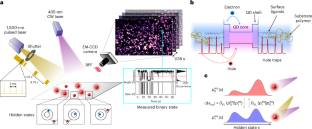
The work required to drive a system from one state to another comprises both the equilibrium free energy difference and the dissipation associated with irreversibility. As physical processes—such as computing—approach fast limits, calculating this excess dissipation becomes increasingly critical. Yet, precisely quantifying dissipation, more specifically, entropy production, in strongly driven, time-dependent, realistic nanoscale systems remains a considerable challenge. Consequently, previous studies have largely been limited to either idealized Markovian systems under time-dependent driving or non-Markovian steady-state systems under constant driving. Here we measure the full dynamics of trajectory-level entropy production in a non-stationary, non-Markovian material arising from time-dependent driving. We use machine learning to extract the entropy produced by a quantum dot stochastically blinking under a stepwise control protocol. The entropy produced corresponds to the loss of memory in the material as the carrier distribution evolves. In addition, our approach quantifies both information insertion and dissipation under a quenched protocol. This work demonstrates a simple and effective approach for visualizing dissipation dynamics following a fast quench and serves as a stepping stone towards optimizing energy costs in the control of real materials and devices.