2026-01-26 中国科学院(CAS)
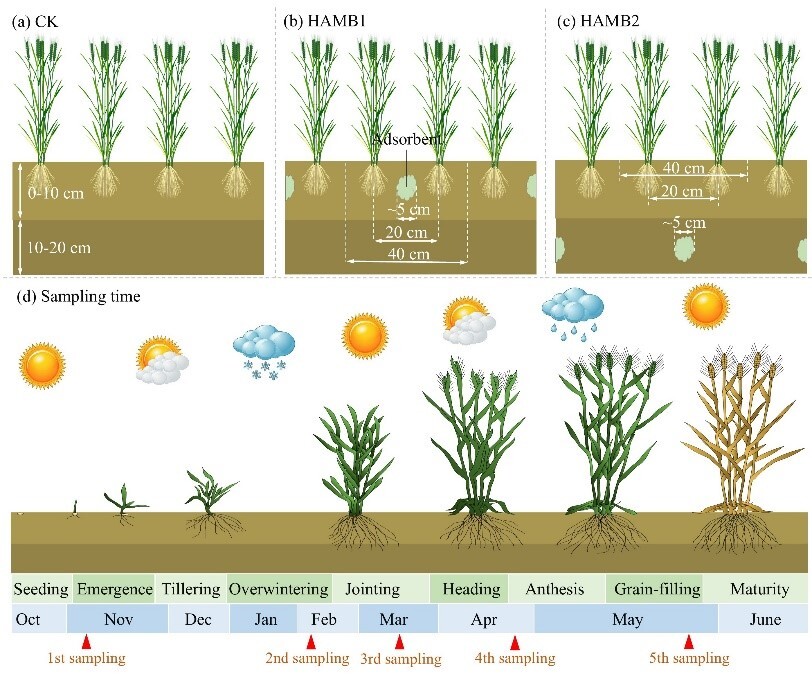
Placement of HAMB in the soil layers and the sampling time (Image by YANG Yang)
<関連情報>
- https://english.cas.cn/newsroom/research-news/202602/t20260213_1150961.shtml
- https://link.springer.com/article/10.1007/s11368-025-04207-3
フミン酸改質ベントナイトによる土壌アンモニウム保持力の向上 Enhancing soil ammonium retention with humic acid-modified bentonite
Na Li,Sinan Li,Feng Li,Xiaohua Shen,Xiaoyu Ni,Ye Yang & Yang Yang
Journal of Soils and Sediments Published:14 January 2026
DOI:https://doi.org/10.1007/s11368-025-04207-3
Abstract
Purpose
Soil ammonium (NH4+) loss via leaching and ammonia (NH3) volatilization threatens agricultural sustainability and environmental quality. This study explored the effects of humic acid-modified bentonite (HAMB) on soil NH4+ retention and nitrogen loss mitigation, to support soil fertility maintenance and sustainable agricultural nitrogen management.
Methods
Three treatments [the control (CK), HAMB applied in 0 − 10 cm layer (HAMB1), and HAMB applied in 10 − 20 cm layer (HAMB2)] were set in a wheat field during 2020 − 2023. Soil samples were collected to measure NH4+ adsorption and desorption, potential NH4+ leaching, and potential NH3 volatilization. Langmuir adsorption isotherm model was used to determine soil NH4+ adsorption parameters (Qmax, k, and MNBC).
Results
HAMB application enhanced NH4+ adsorption, suppressed NH4+ desorption (effects lasting 6 − 7 months), increased Qmax, MNBC (effects lasting 5 − 6 months), and k (effects lasting 1 month), and reduced potential NH4+ leaching by 5.2% − 31.0% and NH3 volatilization by 5.7% − 58.3% (effects lasting ~ 7 months). These effects extended vertically to the subsoil layers (10 − 20 cm) below the HAMB-applied horizon. Qmax and MNBC were long-acting key parameters for nitrogen loss regulation.
Conclusions
This study highlights the effects of HAMB application on enhancing soil NH4+ retention and underscores the necessity to optimize its preparation methods to further improve NH4+ adsorption capacity and reduce nitrogen loss. These findings provide substantial support for soil fertility maintenance, environmental pollution mitigation, and sustainable agricultural nitrogen management.