2026-02-06 東北大学
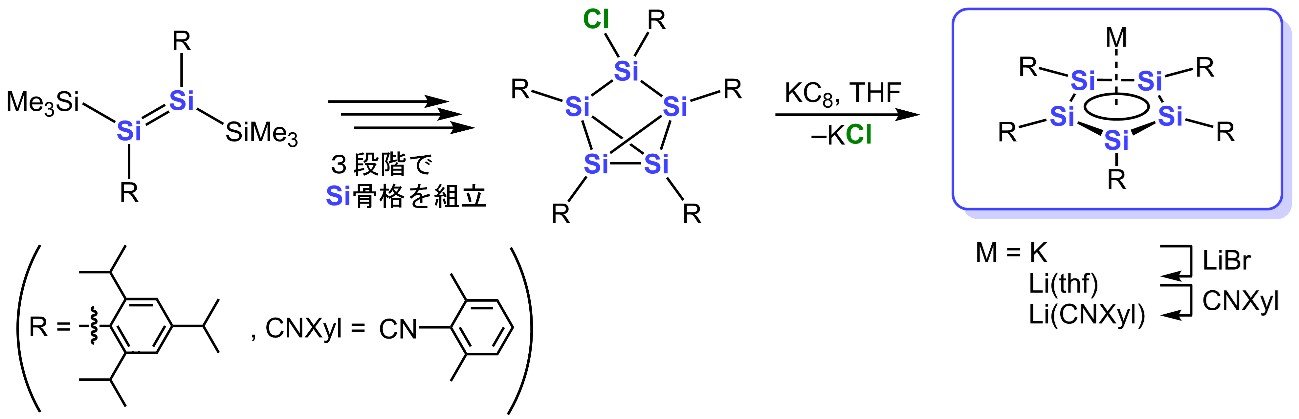
図1. ペンタシラシクロペンタジエニドの合成
<関連情報>
- https://www.tohoku.ac.jp/japanese/2026/02/press20260206-05-silicon.html
- https://www.tohoku.ac.jp/japanese/newimg/pressimg/tohokuuniv-press20260206_05web_silicon.pdf
- https://www.science.org/doi/10.1126/science.aed0168
非平面6π芳香族Si 5環を特徴とするシリコンシクロペンタジエニド Silicon cyclopentadienides featuring a nonplanar 6π aromatic Si5 ring
Takeaki Iwamoto, Tomoki Ishikawa, and Shintaro Ishida
Science Published:5 Feb 2026
DOI:https://doi.org/10.1126/science.aed0168
Editor’s summary
Unlike carbon, silicon naturally tends to produce networks and clusters held together exclusively with single bonds. That hasn’t stopped chemists from artificially coaxing the heavier element into constrained geometries that induce the formation of double or triple bonds. Iwamoto et al. and Ankur et al. independently reported syntheses of negatively charged five-membered silicon rings directly analogous to the well-known cyclopentadienide ligands common in organometallic chemistry. The silicon rings were characterized in solid state and solution and showed signs of some degree of aromaticity in their electronic structure. —Jake S. Yeston
Abstract
Compared with the wide variety of reports on carbon π-electron compounds, the silicon counterparts remain scarce because of the intrinsic preference of silicon to form σ-bonded compounds. In particular, silicon compounds in which π-electrons are delocalized over five or more silicon atoms have been elusive. We report the synthesis of pentasilicon analogs of cyclopentadienides (pentasilacyclopentadienides). These compounds contain nonplanar five-membered silicon rings with some pyramidalized silicon atoms and uneven silicon-silicon distances. The highly shielded 7Li nuclear magnetic resonance signal of a lithium pentasilacyclopentadienide corroborates the presence of a diamagnetic ring current in the five-membered ring, which is indicative of at least some degree of aromaticity. Furthermore, a computational study revealed that bulky substituents and the delocalization of π-electrons stabilize the pentasilacyclopentadienide structure.